Rapid Global supported a pump manufacturer with a benchmark of its centrifugal pumps against competitors, FEA-validated design optimisation with a rationalised component library, and the conversion of 2,600+ legacy 2D drawings into 3D models and ASME Y14.5 drawings.
| Client | Confidential |
| Product | Centrifugal pumps |
| Services | Consulting · Design optimisation · FEA · CAD support |
| Scope | 2,600+ drawings converted |
01 The challenge
The client wanted to strengthen its centrifugal pump range but faced four connected problems, each of which limited how quickly it could improve its products.
- No objective market view. The client had no structured comparison of its pumps against competitors on performance, construction, material and price.
- Heavier designs. Weight needed to come down without compromising hydraulic performance or structural integrity.
- Limited interchangeability. A large component library with too few shared parts added cost to design, inventory and the supply chain.
- Legacy 2D drawings. More than 2,600 drawings were held in 2D, which limited reuse and made design changes slow.
Our response: benchmark, optimise and digitise.
02 Benchmarking and gap analysis
We benchmarked the client’s pumps against its competitors across four dimensions and mapped the results onto the existing product basket, to show where the range was strong, where it was exposed, and which gaps to close first.
What we benchmarked
| Performance | Flow, head, efficiency, power and NPSH required at the duty point, compared across the competing range. |
| Construction | Casing and impeller design, bearing bracket, shaft sealing and bearing arrangement. |
| Material | Materials of casing, impeller, shaft and wear parts, and their suitability for the service. |
| Price | Unit price set against the performance delivered, to show where value was won or lost. |
Key gaps identified (12 in total)
| Parameter | Gap vs best-in-class competitor | Priority |
|---|---|---|
| Efficiency at BEP | 2 to 4 percentage points lower | High |
| NPSH required | 0.5 to 1.0 m higher at rated flow | High |
| Hydraulic coverage | 6 duty points not covered by the range | Medium |
| Pump weight | 8 to 12% heavier for an equivalent rating | High |
| Price to performance | 5 to 7% behind the leading competitor | Medium |
Each gap was quantified against the benchmark and ranked by its effect on performance and market position, giving a clear brief for design optimisation.
Standards referenced
- API 610 (ISO 13709): centrifugal pumps for petroleum, petrochemical and natural gas industries
- API 682 (ISO 21049): shaft sealing systems for centrifugal and rotary pumps
- Hydraulic Institute HI 1.3: design and application
- Hydraulic Institute HI 14.6: hydraulic performance acceptance tests
Applicability to be confirmed against the client’s specification and the pump class.
03 Design optimisation and component rationalisation
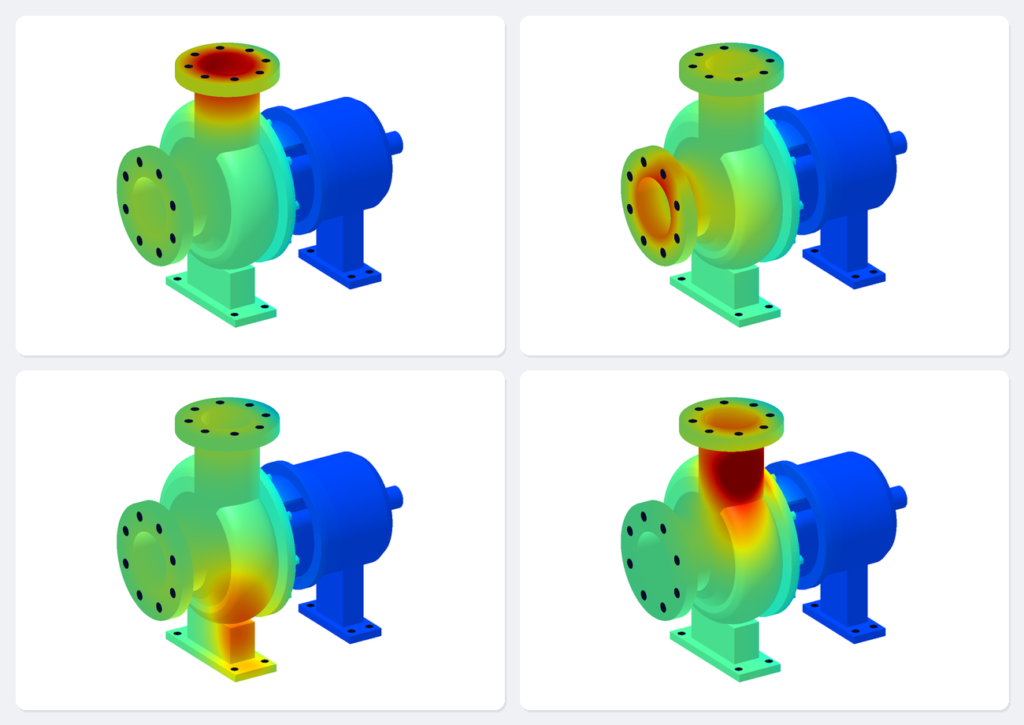
Building on the benchmark, we reworked the client’s designs to reduce weight. Each change was checked by finite element analysis (FEA) before it was accepted, so that pump performance and structural integrity were not affected. In parallel, we rationalised the component library to increase interchangeability.
- 5% average weight reduction. Material was removed where the analysis showed it was not working, and each revised part was re-checked by FEA before release.
- 7% reduction in inventory. More parts are now shared across pump sizes, cutting unique part numbers to stock and simplifying sourcing across the supply chain.
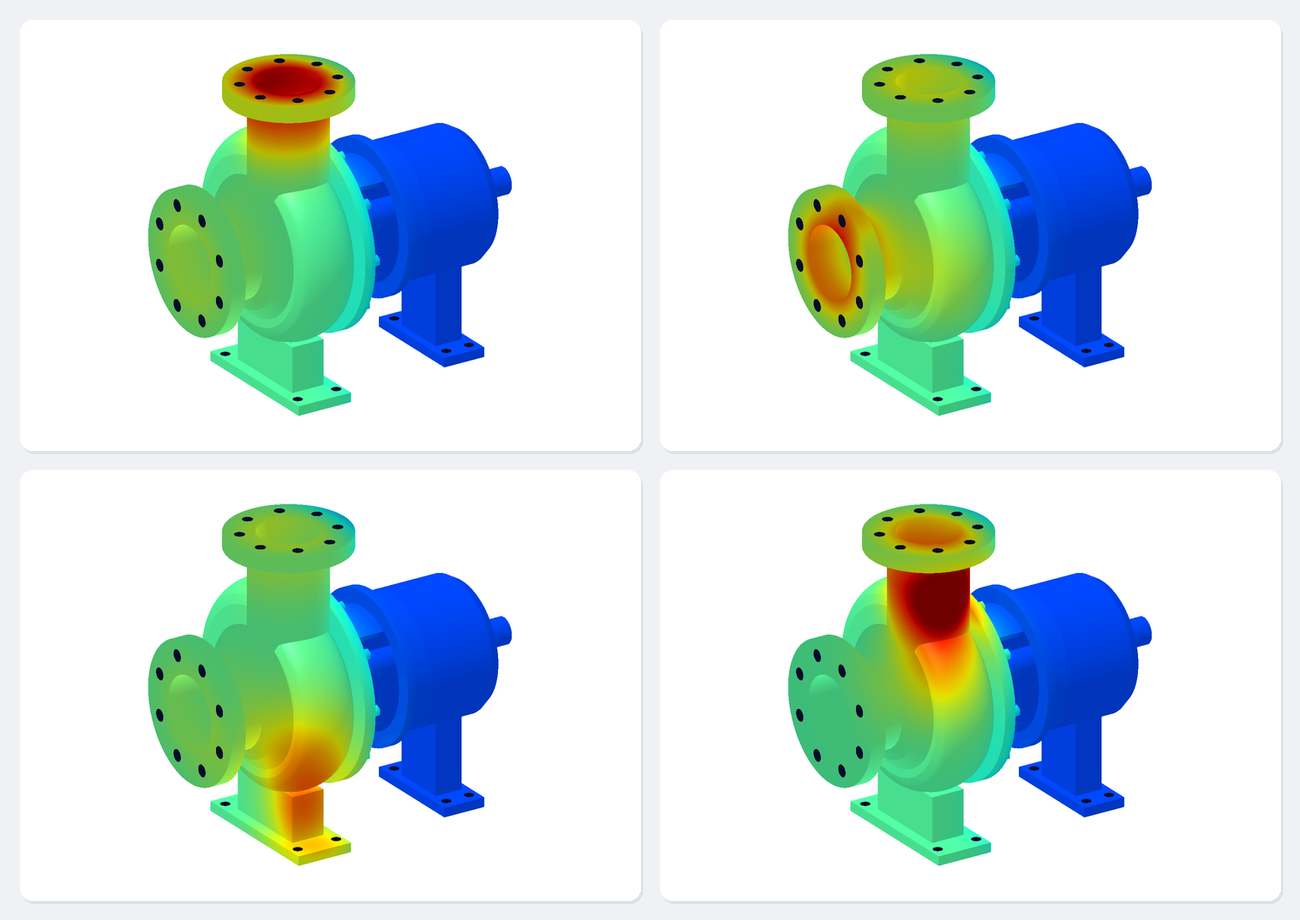
| Model | Pump casing with nozzle flanges, bracket and mounting feet |
| Supports | Fixed at mounting feet |
| Validation | Stresses within allowable limits after weight reduction; pump performance unaffected |
| Outcome | Average 5% weight reduction |
04 Legacy 2D drawings to 3D CAD
The client’s design knowledge sat in more than 2,600 legacy 2D drawings, produced over many years to differing practices. Without 3D models, parts could not be analysed, reused or changed quickly.
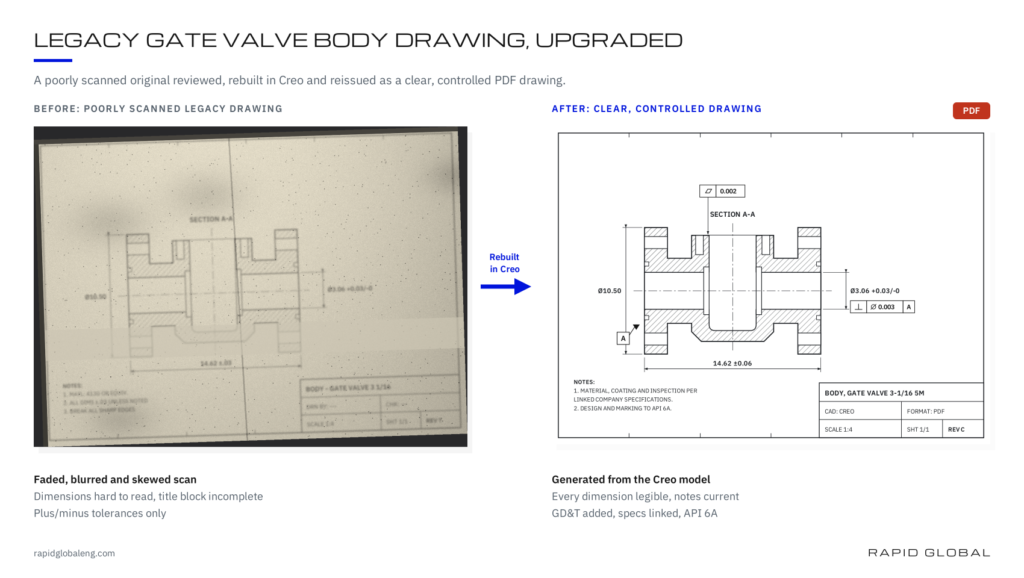
Our CAD team converted the archive into parametric 3D models and re-drafted every drawing from the model to ASME Y14.5, giving the client one consistent, controlled set of design data: 2,600+ legacy 2D drawings converted to 3D models and ASME Y14.5 drawings.
How the conversion worked
- Audit and classify. Drawings collected, indexed and grouped into part families. Duplicates, obsolete revisions and missing information were logged before modelling started.
- Parametric 3D modelling. Each part rebuilt as a parametric 3D model that captures design intent. Part families are table-driven, so sizes share one master model.
- Assemblies and bills of materials. Parts assembled into pump assemblies to check fit and interference, with bills of materials generated directly from the models.
- Drafting to ASME Y14.5. Drawings produced from the models with datums, GD&T feature control frames, and consistent title blocks, notes and tolerances.
- Quality check and release. Every model and drawing checked against the legacy original, discrepancies resolved with the client, and files released in native and neutral formats.
What the client gained
- One source of truth. A controlled 3D master for each part, with every drawing derived from it.
- Ready for analysis. Models feed straight into FEA and design optimisation, as in section 03.
- Faster change. Engineering changes and new variants are made in the model, not redrawn by hand.
05 Results
Across the three phases, the client gained an objective view of its market position, lighter pumps with unchanged performance, a leaner component library and a complete, standardised set of 3D design data.
| 12 | performance and product gaps identified and ranked against competitors |
| 5% | average weight reduction, validated by FEA with pump performance unaffected |
| 7% | reduction in inventory through component rationalisation and a simpler supply chain |
| 2,600+ | legacy 2D drawings converted to 3D models and ASME Y14.5 drawings |
Services delivered
Consulting · Competitor benchmarking · Gap analysis · Design optimisation · FEA · Component rationalisation · CAD conversion · Drafting to ASME Y14.5
Bring us in early and the schedule stays yours. Talk to Rapid Global.