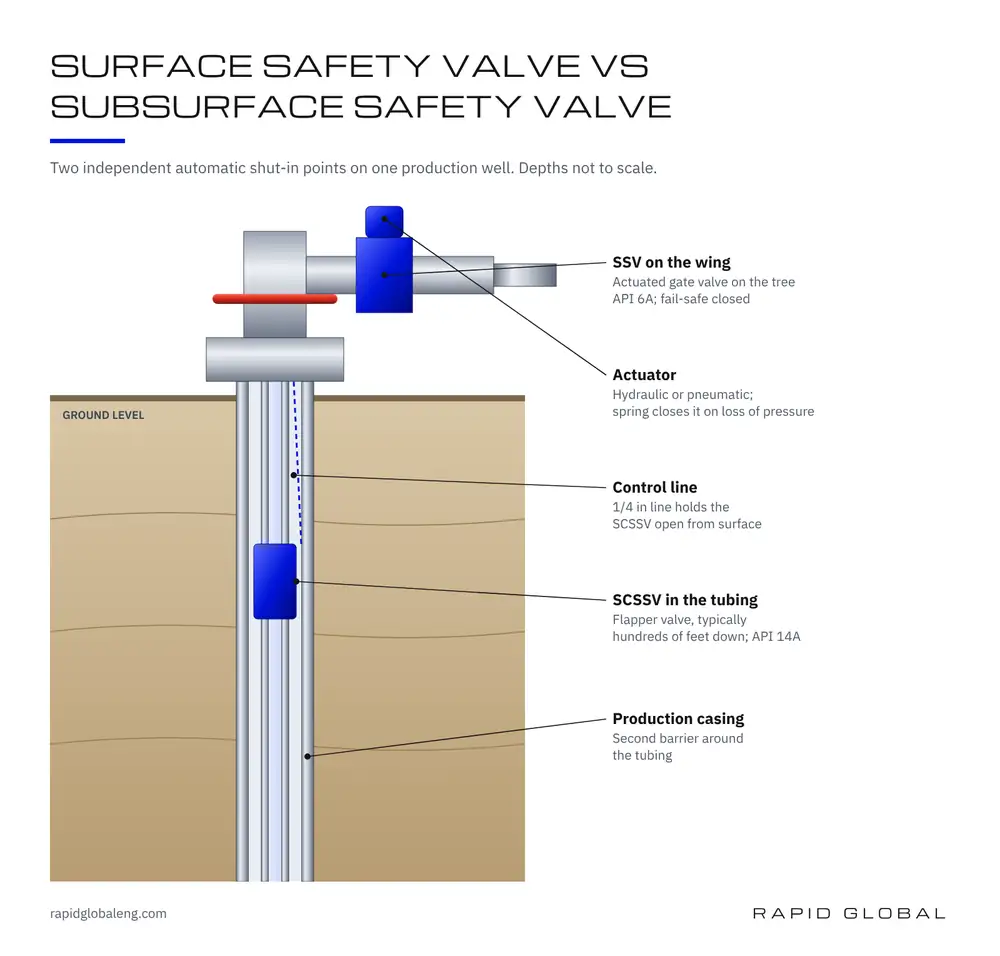
A producing well has two automatic valves whose only job is to shut the well in when something goes wrong: the surface safety valve (SSV) on the tree, and the subsurface safety valve (SCSSV) in the tubing. They work together, but they protect against different events.
Surface safety valve (SSV)
An SSV is an actuated gate valve on the Christmas tree, usually the upper master valve or the production wing valve. A hydraulic or pneumatic actuator holds it open against a spring. If control pressure is lost, the spring closes the valve. This “fail-safe closed” design means a cut line, a fire or a shutdown signal all end in a closed valve.
SSVs are covered by API 6A, which absorbed the older API 14D requirements.
Subsurface safety valve (SCSSV)
An SCSSV sits in the tubing, typically several hundred feet below the surface or the seabed. Most use a flapper. A 1/4 in control line from surface carries hydraulic pressure that holds the flapper open. Bleed off that pressure and a spring closes it.
Its value is that it still works if the tree itself is damaged, for example by a collision or a fire at the wellhead. SCSSVs are covered by API 14A. They come in two forms:
- Tubing-retrievable (TRSV): part of the tubing string; full bore, but the tubing must be pulled to replace it.
- Wireline-retrievable (WRSV): set in a landing nipple; easy to replace, with a smaller bore.
Side by side
| SSV | SCSSV | |
|---|---|---|
| Location | On the tree, at surface | In the tubing, below surface |
| Closing element | Gate | Usually a flapper |
| Held open by | Actuator pressure | Control line pressure |
| Protects against | Downstream upsets and process trips | Loss of the tree or wellhead |
| Standard | API 6A | API 14A |
How they work together
In a typical shutdown, the SSV closes first because it is fast and easy to test and repair. The SCSSV is closed for more serious events, or after the SSV, so the flapper does not have to slam shut against full flow. Both are part of the well barrier envelope and are tested regularly.
Frequently asked questions
Is an SSV required on every well?
Requirements depend on the regulator and the operator. Offshore and high-risk onshore wells nearly always have both.
What is a USV?
An underwater safety valve, the subsea equivalent of an SSV, mounted on a subsea tree.
For tree basics, see What is a Christmas tree?.
Work with RAPID GLOBAL
RAPID GLOBAL designs, analyses and requalifies wellhead, subsea and valve equipment to API standards. If you need help with safety valve or actuator projects, talk to an engineer.