A casing hanger does two jobs. It transfers the weight of a casing string to the wellhead, and it seals the annulus between that casing and the one outside it. There are two basic ways to do this: grip the casing with slips, or thread a solid hanger body onto it.
Slip-type casing hangers
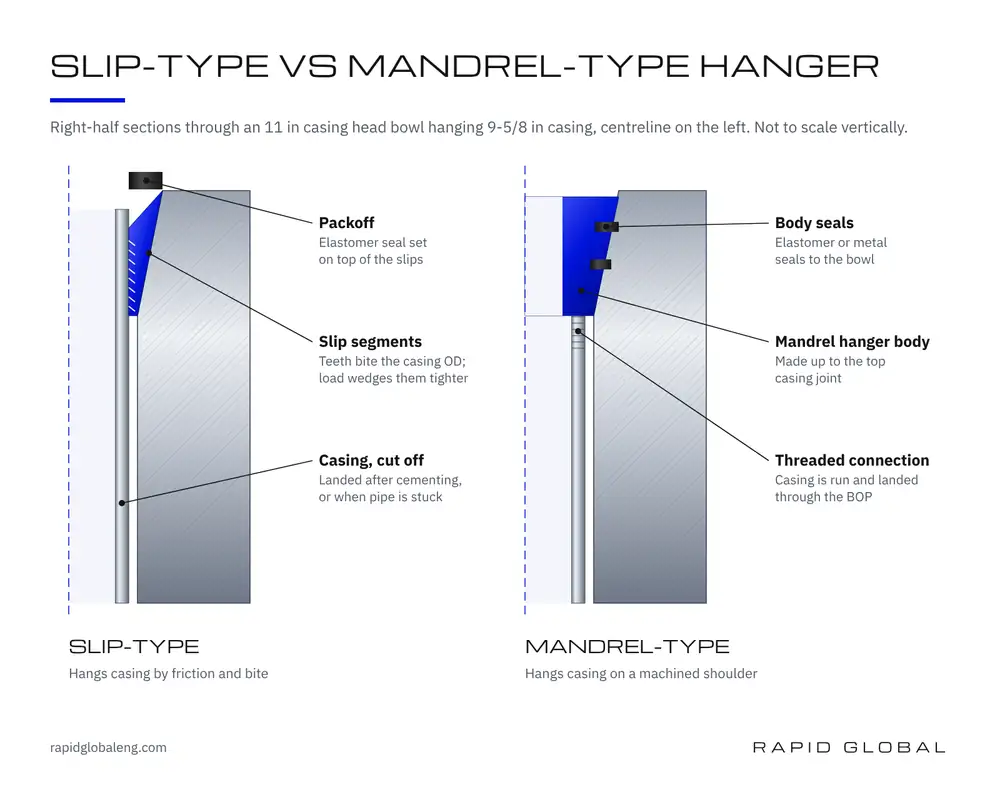
A slip-type hanger wraps around the casing and lands in the tapered bowl of the casing head or spool. Its slip segments have hardened teeth on the inside. As the casing weight is slacked off, the slips are pulled down the taper and wedge tighter against the casing. A packoff above the slips then seals the annulus, either energised by the casing weight or set manually.
The casing is cut off above the hanger and dressed so the next spool can be installed.
- Strengths: can be set at any point on the pipe, so it works when casing gets stuck short of depth. Often used as the emergency option.
- Limits: usually installed after the BOP is lifted, which means working under a suspended stack. The slips can damage the pipe surface, and the seal is generally less robust than a mandrel hanger’s.
Mandrel-type casing hangers
A mandrel hanger is a solid body made up to the top joint of the casing string. The casing is run through the BOP and the hanger lands on a load shoulder in the bowl. Seals on the hanger’s outside diameter seal against the bowl.
- Strengths: run and landed through the BOP, so well control is kept while the hanger is set. The landing position is known exactly, and the seal design can be elastomer or metal-to-metal.
- Limits: the casing must reach its planned depth. If it gets stuck, a slip-type hanger is used as a backup.
Side-by-side comparison
| Slip-type | Mandrel-type | |
|---|---|---|
| How it holds the casing | Friction and teeth on the casing OD | Threaded connection and a load shoulder |
| Installed through the BOP? | Usually not | Yes |
| Copes with stuck casing | Yes | No |
| Annulus seal | Packoff above the slips | Seals on the hanger body |
| Typical use | Onshore, lower pressure, emergency backup | Higher pressure, offshore, compact and subsea wellheads |
How to choose
Most operators default to mandrel hangers for the main strings because they keep the BOP in place and give a more predictable seal. Slip hangers remain the practical choice for lower-pressure land wells and as the contingency when a string does not reach bottom. Either way, the hanger’s load rating must cover the string’s buoyed weight plus any overpull. Our buoyancy factor post shows how to estimate that weight.
Frequently asked questions
Is a casing hanger covered by API 6A?
Yes. Casing and tubing hangers are API 6A equipment, with load ratings and, for mandrel hangers, pressure and material requirements.
What is an emergency slip hanger?
A slip-type hanger kept on location for a well planned with mandrel hangers. If the casing gets stuck, the emergency hanger is set at whatever depth the pipe reached.
For a wider view of where hangers sit, see Wellhead Equipment 101.
Work with RAPID GLOBAL
RAPID GLOBAL designs, analyses and requalifies wellhead, subsea and valve equipment to API standards. If you need help with hanger design, load rating or requalification, talk to an engineer.