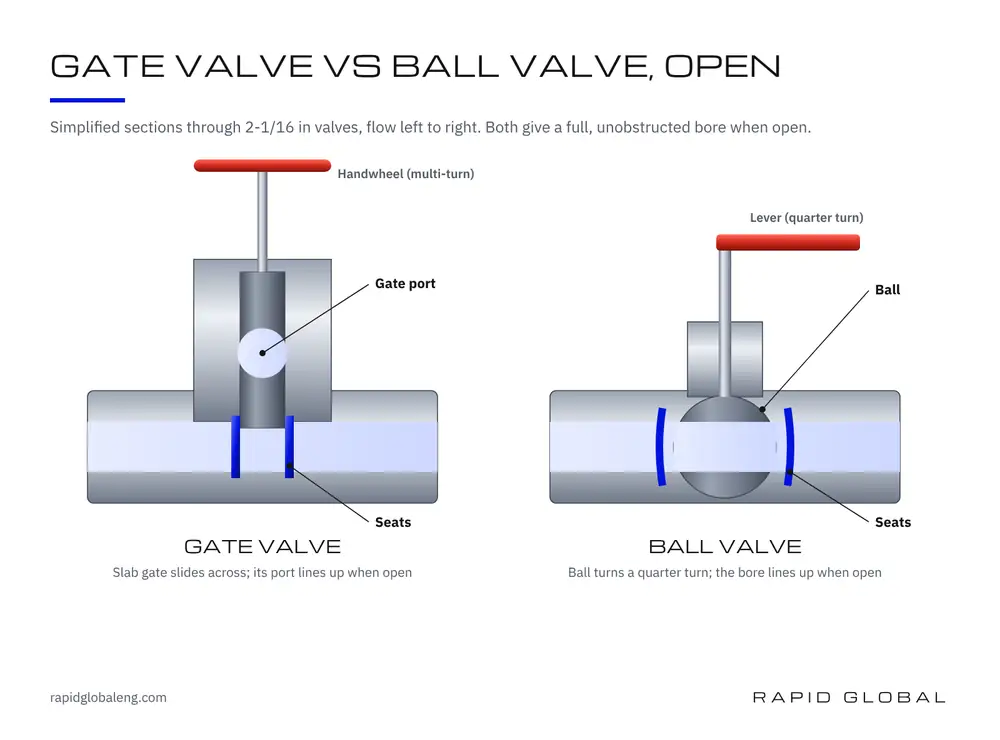
Gate valves and ball valves both give a full, unobstructed bore when open, and both are used throughout oil and gas. They are not interchangeable, though. Christmas trees still use gate valves almost everywhere, while pipelines use ball valves heavily. The reasons are in how each valve seals.
How a gate valve works
A slab gate slides across the bore between two seats. When open, a port in the gate lines up with the bore. When closed, line pressure pushes the gate against the downstream seat, giving a metal-to-metal seal. A handwheel or actuator drives the stem through many turns. See our API 6A gate valve guide for the parts in detail.
How a ball valve works
A ball with a bore through it rotates a quarter turn between two seats. Floating ball valves let the ball move against the downstream seat; trunnion-mounted valves hold the ball on fixed axes and use spring-loaded seats, which suits larger sizes and higher pressures.
Comparison
| Gate valve | Ball valve | |
|---|---|---|
| Operation | Multi-turn, slower | Quarter turn, fast |
| Typical seat seal | Metal-to-metal | Soft or metal seats |
| Tolerance to sand and solids | Good; the gate wipes the seats | Lower; solids can score the ball |
| Wireline and coil access | Straight-through bore; can cut wireline in some designs | Full bore, but not intended to cut |
| Size and weight | Taller | More compact in small sizes |
| Main standards | API 6A (trees), API 6D (pipelines) | API 6D, API 6A in some sizes |
Why trees use gate valves
- Metal-to-metal seats hold high pressure and temperature without relying on soft seals.
- The gate tolerates sand and scale better than a ball.
- Actuated gate valves make reliable fail-safe surface safety valves.
- Decades of field data and established repair practice.
Where ball valves win
Ball valves suit clean service where fast operation and low torque matter: pipelines, process plant, chemical injection and many small-bore wellhead applications. Trunnion ball valves dominate large-diameter pipeline service under API 6D.
Frequently asked questions
Can a ball valve be used on a Christmas tree?
It can in some designs and sizes, but gate valves remain the default for master and wing valves.
Which valve is cheaper?
In small sizes ball valves are often cheaper. In high-pressure wellhead sizes the difference narrows, and life-cycle cost usually favours the gate valve.
The standards difference is covered in API 6A vs API 6D.
Work with RAPID GLOBAL
RAPID GLOBAL designs, analyses and requalifies wellhead, subsea and valve equipment to API standards. If you need help with valve design or qualification, talk to an engineer.