
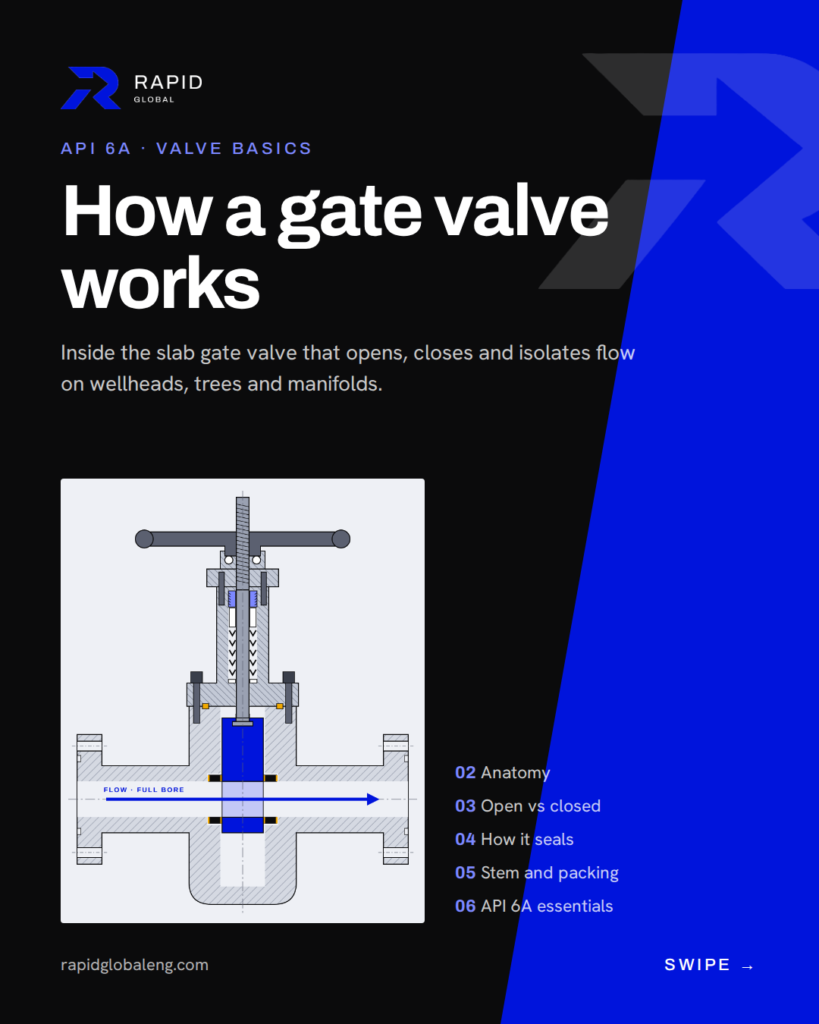
An API 6A gate valve is the workhorse isolation valve on wellheads, Christmas trees, frac trees and choke manifolds. This guide explains how a gate valve works, names every part on a labelled section drawing, shows how a slab gate valve seals metal to metal, and sums up what API Specification 6A controls.
Download the free 6-page guide (PDF)
Anatomy, open vs closed, sealing, stem packing and API 6A essentials, in one printable PDF.
What is an API 6A gate valve?
A gate valve opens and closes a flow path by sliding a flat gate across the bore, at right angles to the flow. When it is open, the bore is completely clear. When it is closed, the gate sits between two seats and blocks the line.
API 6A (ISO 10423) is the specification for wellhead and Christmas tree equipment. An API 6A gate valve is designed, built and tested for well pressures from 2,000 to 20,000 psi, with defined temperature classes, material classes and quality levels. The most common design in wellhead and tree service is the slab gate valve: a one-piece gate with a bore-sized hole through it, running between two floating seats.
API 6A gate valve parts (with diagram)
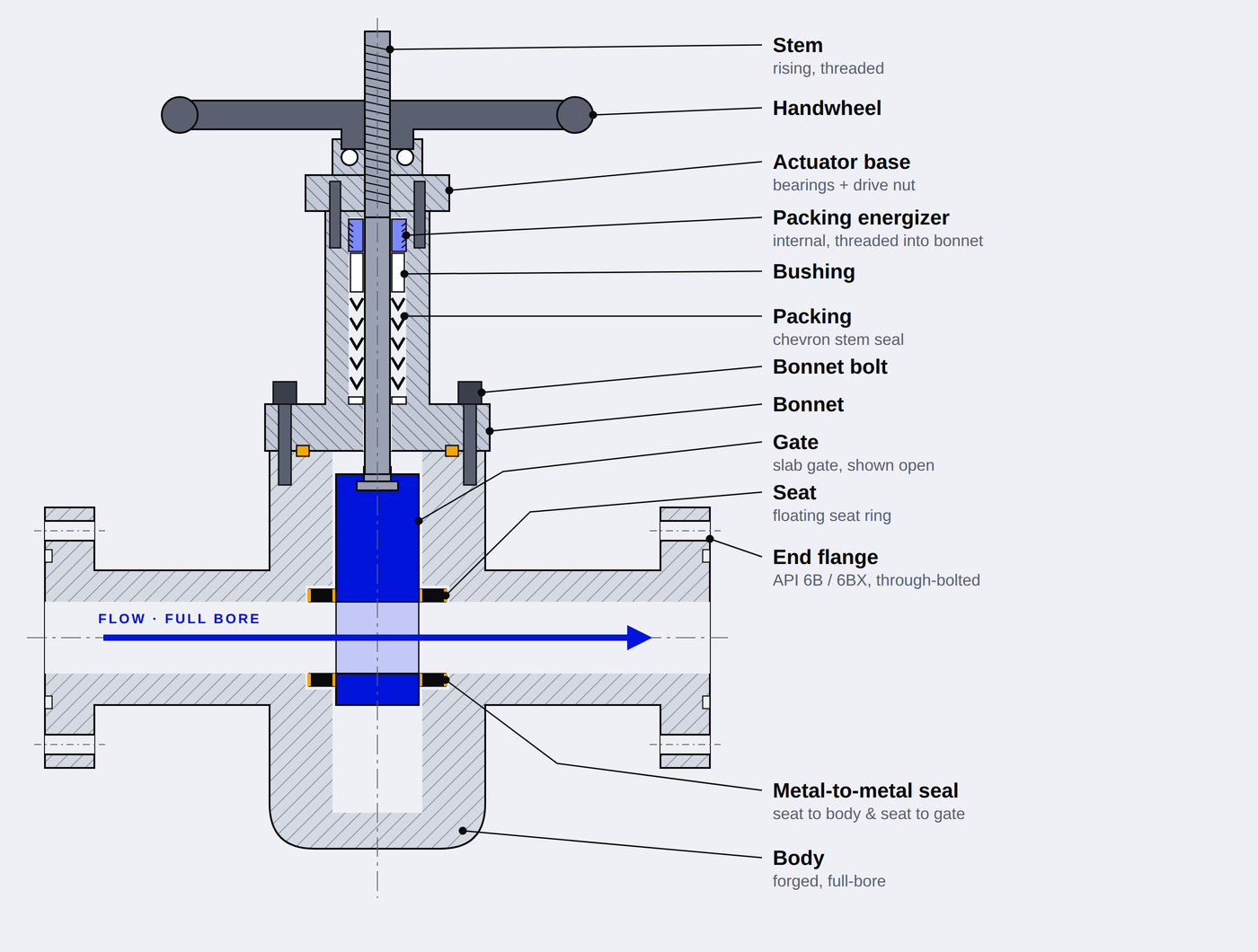
The gate valve parts fall into three groups by job.
Parts that contain pressure
- Body: forged, full-bore, with a cavity below the bore for the gate to travel into.
- End flanges: API 6B or 6BX ring-joint flanges, bolted through to the next piece of equipment.
- Bonnet and bonnet bolts: the bonnet closes the top of the body cavity, bolted down on a metal ring gasket.
Parts that stop the flow
- Gate: a one-piece slab with a through-bore the same size as the valve bore.
- Seats: two thin floating seat rings, one each side of the gate, in shallow pockets in the body.
- Metal-to-metal seal: the gate-to-seat and seat-to-body faces that hold pressure when the valve is closed.
Parts that move the gate
- Handwheel and actuator base: the handwheel turns a drive nut held on bearings in the actuator base.
- Stem: a rising, threaded stem that lifts and lowers the gate.
- Stem packing, bushing and packing energiser: chevron packing seals the stem. A bushing and an internal energiser threaded into the bonnet hold it under preload.
How does a gate valve work?
The gate valve working principle is a straight-line movement of the gate between two positions.
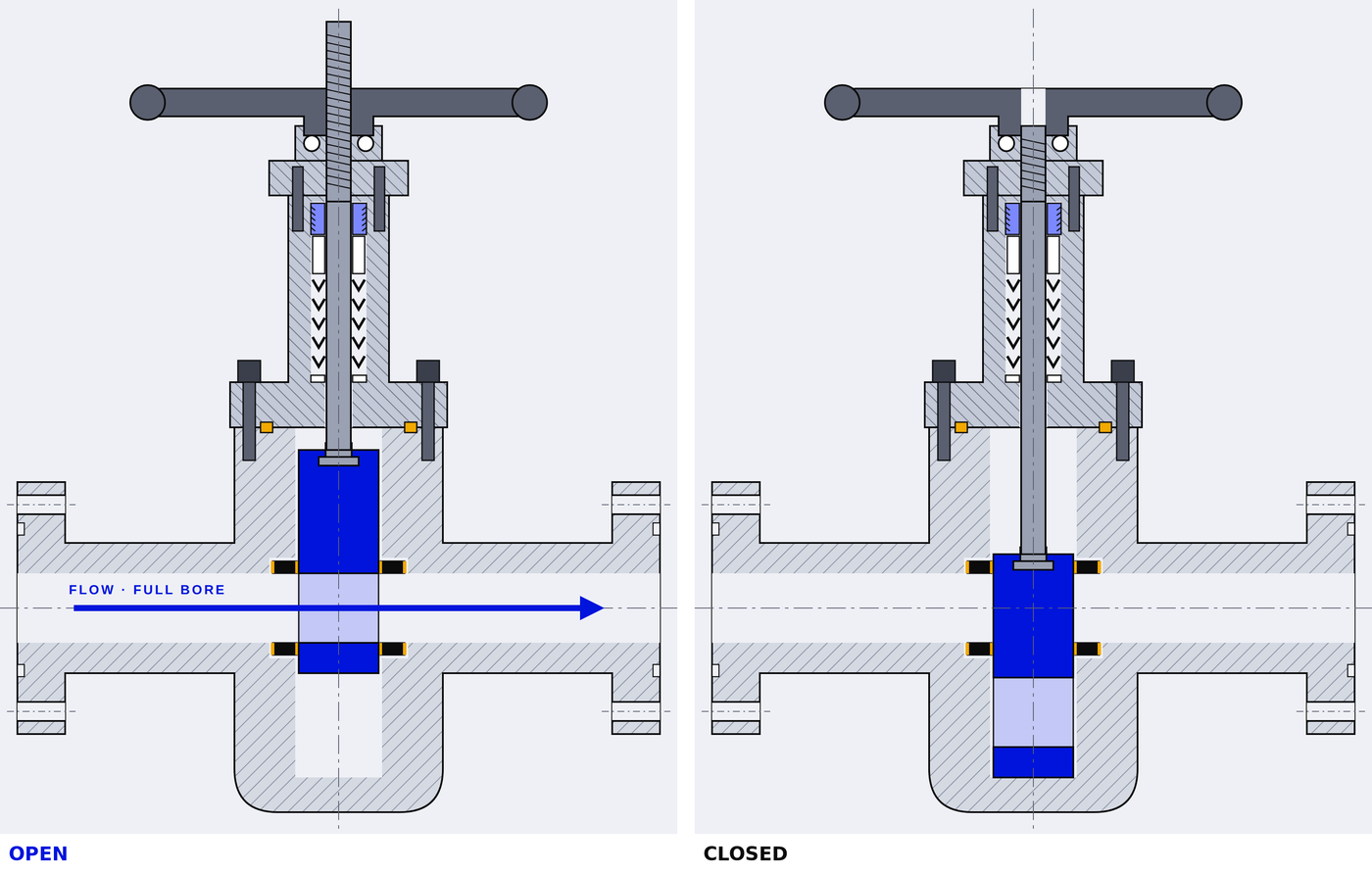
- The operator turns the handwheel.
- The drive nut turns in its bearings in the actuator base.
- The threaded stem rises (open) or lowers (closed).
- The gate slides between the seats.
Open: the stem is up and the gate’s through-bore lines up with the flow bore. Flow passes through a full, unobstructed bore with negligible pressure drop, and the line can be pigged.
Closed: the stem is down and the solid part of the gate sits across the bore, against both seats.
A gate valve is an on/off valve. Running it part-open puts high-velocity flow across the gate and seat faces and erodes them, so throttling belongs to a choke, never a gate valve.
How a slab gate valve seals: metal-to-metal, pressure assisted
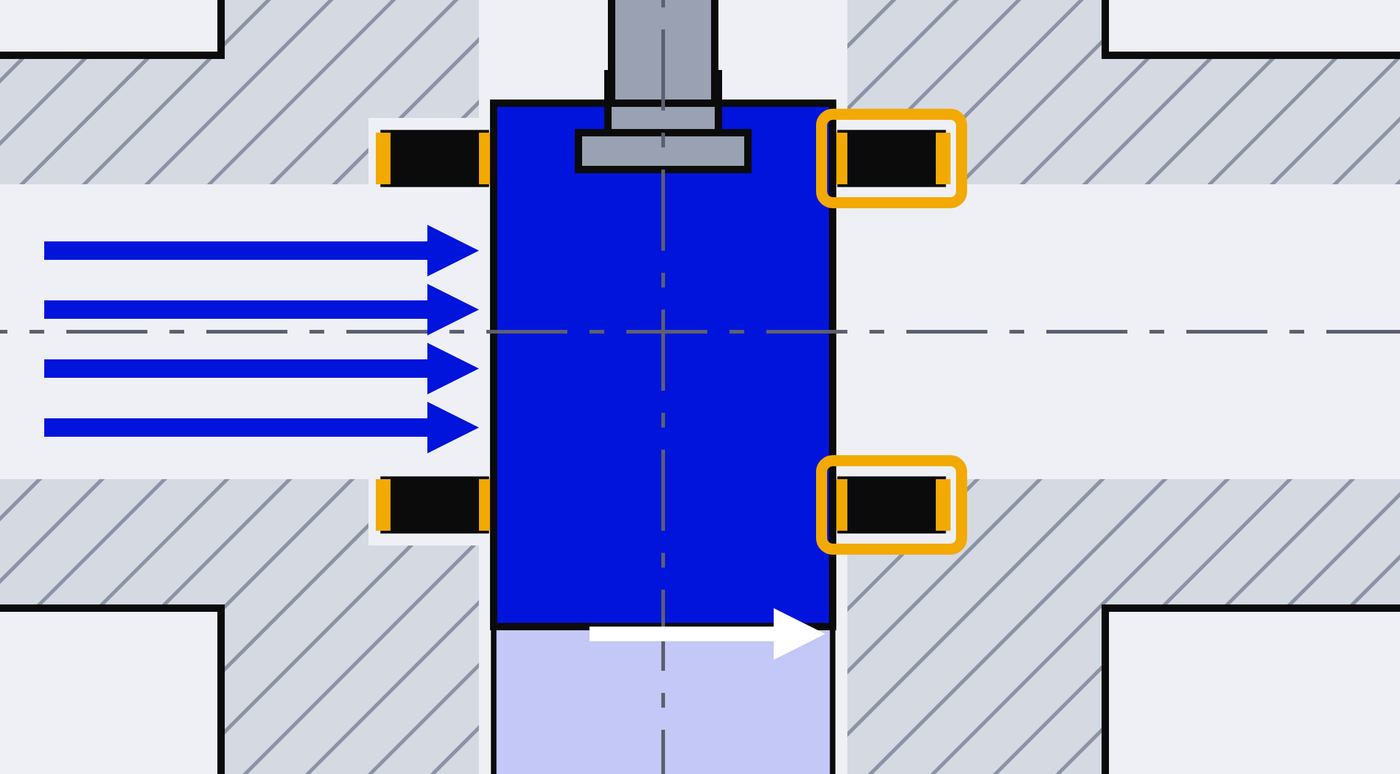
- Pressure loads the gate. Upstream line pressure acts on the full face of the closed gate.
- The gate floats downstream. The gate shifts a very small distance and bears on the downstream seat.
- Metal meets metal. The gate-to-seat and seat-to-body faces seal. The higher the pressure, the higher the contact stress on those faces.
Because the seal comes from line pressure acting on a symmetrical gate and seats, a slab gate valve seals from either direction. No sealant injection is needed to hold pressure.
Stem, packing and the rising stem
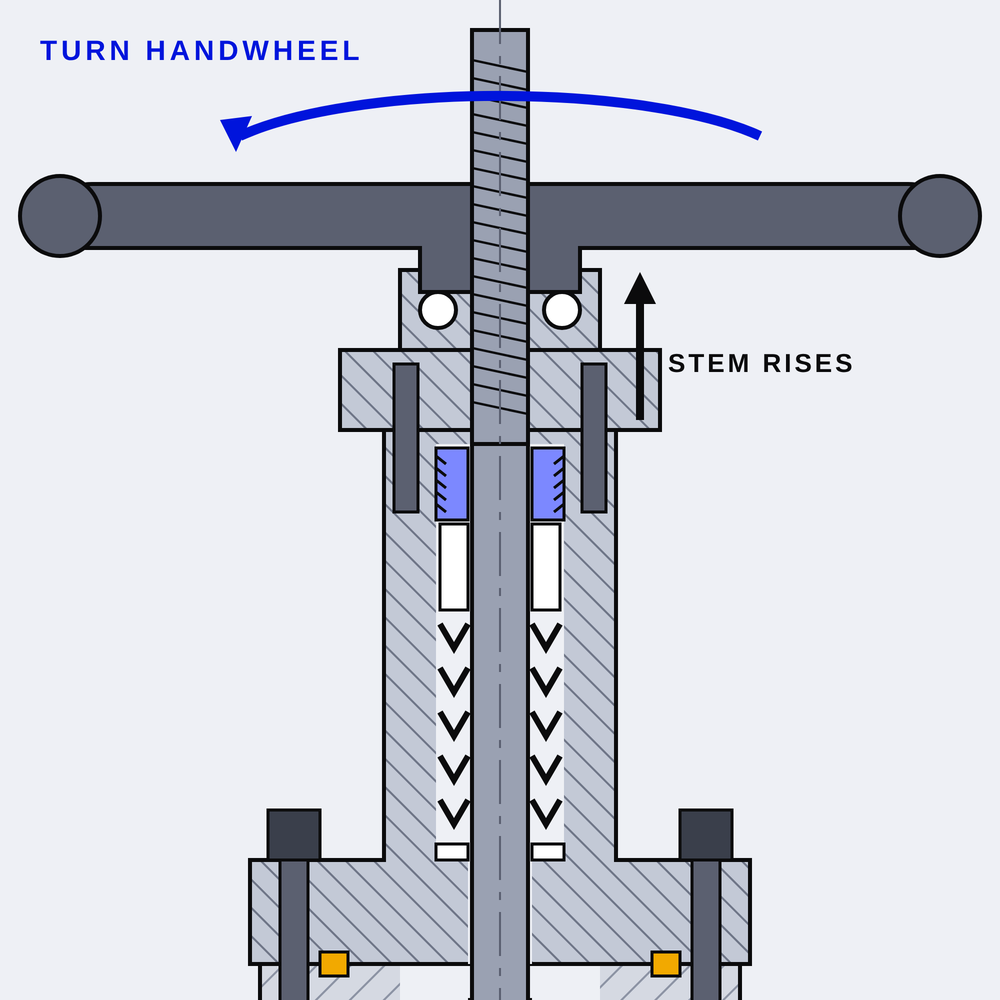
- Drive nut on bearings: the bearings carry the stem thrust, so the handwheel turns smoothly even with full pressure in the valve.
- Rising stem shows position: the stem climbs as the valve opens, so a stem that is up means the valve is open.
- Chevron packing: V-rings seal the stem in the bonnet, and pressure spreads their lips to tighten the seal.
- Internal energiser: a threaded ring inside the bonnet preloads the packing through the bushing, with no external gland studs to adjust or snag.
What API 6A specifies for gate valves
| Parameter | What it defines |
|---|---|
| Rated working pressure | 2,000 / 3,000 / 5,000 / 10,000 / 15,000 / 20,000 psi, matched to the end connections |
| Temperature class | Letter codes K to V, for example L (−46 to 82 °C) and U (−18 to 121 °C) |
| Material class | AA to HH. Sour service also follows NACE MR0175 / ISO 15156 |
| Product specification level | PSL 1 to 4. Each level adds inspection, NDE, testing and traceability |
| Performance requirement | PR1 or PR2. PR2 adds design validation with cycle and temperature testing |
| Factory acceptance testing | Hydrostatic shell test above rated working pressure, then seat tests on every valve |
Exact test pressures, hold times and acceptance criteria are set by the current edition of API 6A and the PSL ordered. Always confirm them against the specification.
Slab gate vs expanding gate valve
An API 6A slab gate valve uses a one-piece gate and relies on line pressure to push the gate onto the downstream seat. An API 6A expanding gate valve uses a two-piece gate and segment that wedge apart mechanically as the valve reaches its end position, so it seals both seats at once even with little or no line pressure. Slab gates are simpler and have fewer parts. Expanding gates are chosen where a mechanical seal at low pressure matters.
Frequently asked questions
Can a gate valve be used for throttling?
No. A gate valve should be fully open or fully closed. A partly open gate erodes the gate and seat faces. Use a choke valve to control flow rate.
Is an API 6A slab gate valve bidirectional?
Yes. The gate and seats are symmetrical, so line pressure from either side pushes the gate onto the opposite seat and seals it.
What is the difference between a rising stem and a non-rising stem gate valve?
In a rising stem valve, the stem moves up and down with the gate, which gives a visual position indicator. In a non-rising stem valve, the stem turns in place and the gate travels on the stem thread, which saves height above the valve.
What does PSL mean on an API 6A valve?
PSL is the product specification level, from 1 to 4. Higher levels add stricter material testing, NDE, pressure testing and documentation.
What pressure ratings do API 6A gate valves come in?
2,000, 3,000, 5,000, 10,000, 15,000 and 20,000 psi rated working pressure.
Keep this guide: download the PDF
Anatomy, open vs closed, sealing, stem packing and API 6A essentials, in one printable PDF.
Need help with an API 6A valve?
Rapid Global provides wellhead and valve engineering, CAD and FEA to API standards: design, design verification and qualification support for API 6A equipment. Send us the specification or drawing and we will tell you what it would take.