
Every API 6A valve or wellhead part is built to a performance requirement: PR1 or PR2. It tells you whether the design has been proven by a physical validation test, not just by calculation.
PR1
PR1 is the basic level. The design must meet the standard’s calculation and material rules, and each part passes its factory acceptance tests. The design itself does not have to survive a qualification test at its temperature and cycle limits.
PR2
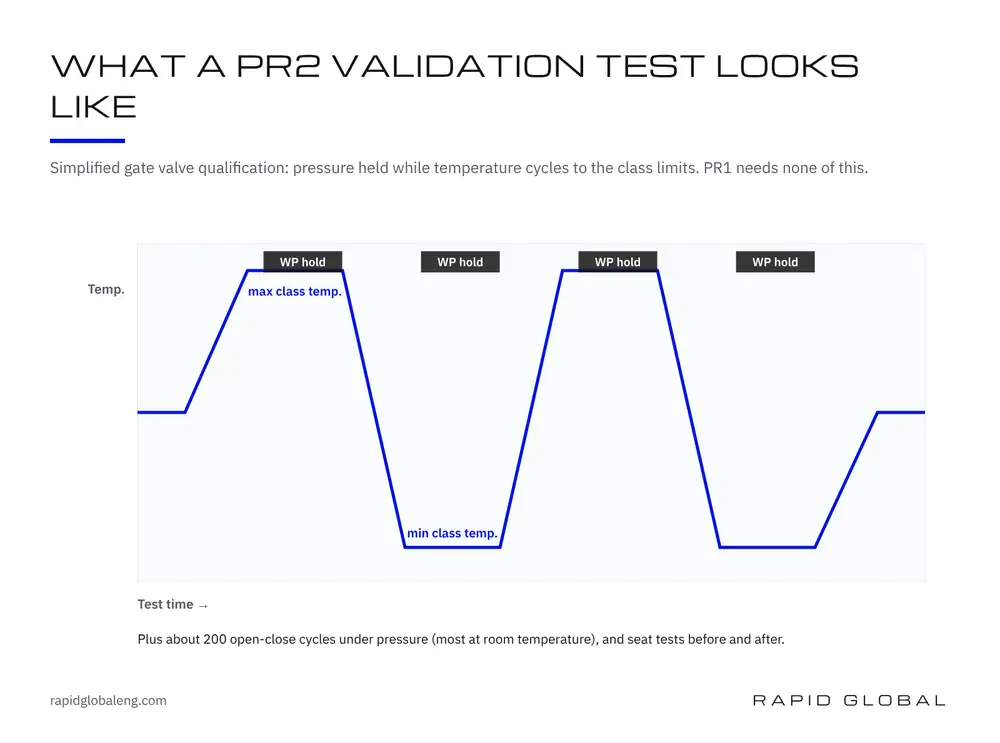
PR2 means a representative unit of the design has passed the validation test in API 6A Annex F. For a gate valve, that test includes:
- Pressure holds at full working pressure while the valve is cycled between the minimum and maximum temperatures of its class.
- A large number of open-close cycles under pressure, around 200 in total for gate valves, most at room temperature.
- Low-pressure and full-pressure seat tests before and after the cycling.
The test proves the seals and seats still work at the hot and cold ends of the rating, after repeated use. That is where field failures tend to happen.
Why most operators specify PR2
- Temperature class only means something if the seals have been tested at those temperatures.
- The test exposes weak points such as seal extrusion, stem packing leaks and seat wear.
- It is a one-time design qualification. Once a design has passed, each unit built to it carries PR2, so the cost per valve is small.
What PR2 does not cover
PR2 qualifies the design, not each unit. Manufacturing quality is covered by the PSL. A change in seal material, design or size can mean the design needs requalifying.
Frequently asked questions
Is PR2 the same as API 6AV1?
No. API 6AV1 is a separate validation for SSVs and USVs in sandy service. PR2 is the general Annex F validation.
How long does a PR2 test take?
Usually several weeks including fixture build, thermal cycling and reporting, depending on the size and temperature range.
Our design validation vs re-rating post explains where testing and analysis each fit.
Work with RAPID GLOBAL
RAPID GLOBAL designs, analyses and requalifies wellhead, subsea and valve equipment to API standards. If you need help with PR2 test planning or design validation, talk to an engineer.

