To take a Christmas tree off a live well, or to put a BOP back on, you need a barrier in the tubing bore. That barrier is a plug set in the tubing hanger, and there are two main types: the back-pressure valve (BPV) and the two-way check valve (TWCV). They look similar and fit the same profile, but they do different jobs.
Where they fit
Most tubing hangers have an internal thread or profile, called the BPV prep, just below the top of the hanger. A BPV or TWCV screws or latches into that profile and seals against the hanger bore. Because it sits below the tree, it isolates the tubing pressure from everything above the hanger. See how a tubing hanger works.
Back-pressure valve (BPV)
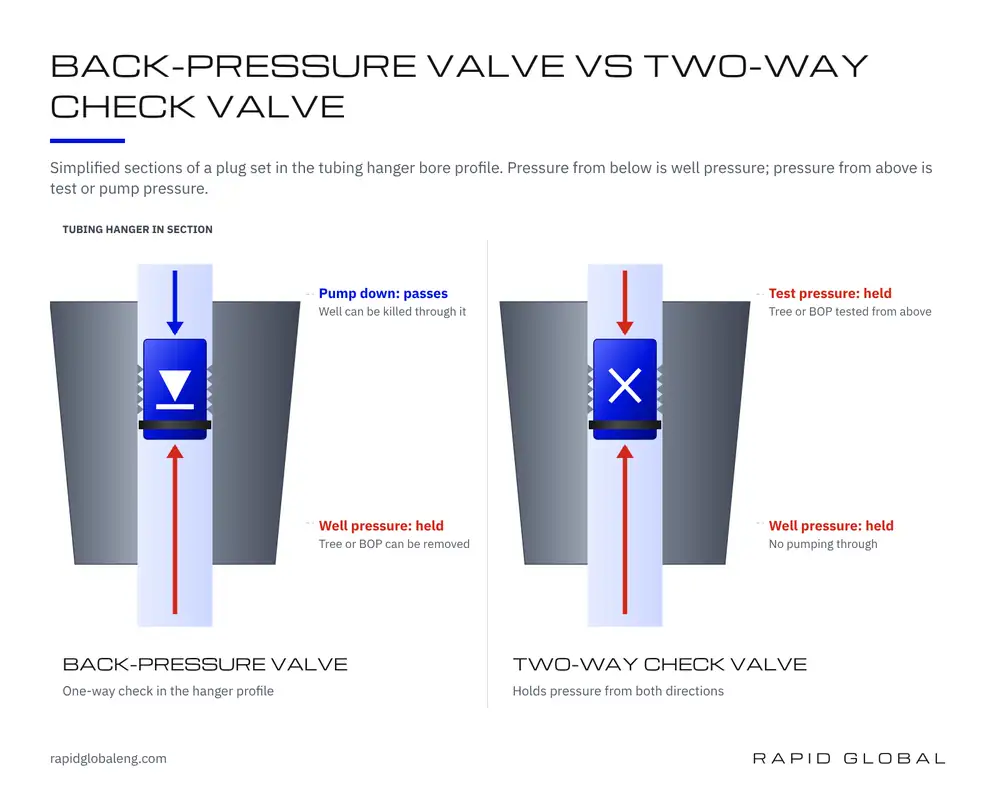
A BPV is a one-way check valve. It holds pressure from below and opens to flow from above.
- Holds well pressure while the tree is removed and the BOP installed, or the other way round.
- Allows pumping down through it. If the well needs to be killed, fluid can still be pumped into the tubing from above.
- Cannot be tested from above, because pressure from above opens it.
Two-way check valve (TWCV)
A TWCV holds pressure from both directions. It is essentially a plug, though most designs have an equalising feature so pressure can be balanced before removal.
- Lets the tree or BOP be pressure tested from above against the plug.
- Still holds well pressure from below.
- Does not allow pumping down, so the well cannot be killed through it.
Typical sequence
- The BPV is set in the hanger through the tree using a lubricator, under pressure.
- The tree is bled off and removed; the BPV holds the well.
- The BOP is installed. The BPV is replaced with a TWCV so the BOP connection can be pressure tested from above.
- After testing, the TWCV is pulled and workover operations begin.
The reverse sequence is used when installing a tree after completion or workover.
Comparison
| BPV | TWCV | |
|---|---|---|
| Holds pressure from below | Yes | Yes |
| Holds pressure from above | No | Yes |
| Pump through from above | Yes | No |
| Main use | Tree or BOP change-out | Pressure testing from above |
Safety points
- Pressure trapped below a plug can launch it. Always check and equalise pressure before retrieving.
- Confirm the plug type before testing from above. Testing against a BPV pressurises the well.
- Inspect the hanger profile. Corroded or damaged threads are a common reason a plug will not set or seal during workovers.
- A BPV or TWCV is one barrier. Your well barrier policy may require a second.
Frequently asked questions
Is a VR plug the same as a BPV?
No. A valve removal (VR) plug seals a side outlet on a spool or tree so a valve can be changed. A BPV seals the tubing hanger bore.
What standard covers BPVs?
BPVs and TWCVs are API 6A equipment, with the same pressure, temperature and material class markings as other wellhead parts.
See how the hanger, tree and BOP fit together in Wellhead vs Christmas Tree.
Work with RAPID GLOBAL
RAPID GLOBAL designs, analyses and requalifies wellhead, subsea and valve equipment to API standards. If you need help with wellhead or hanger design, talk to an engineer.