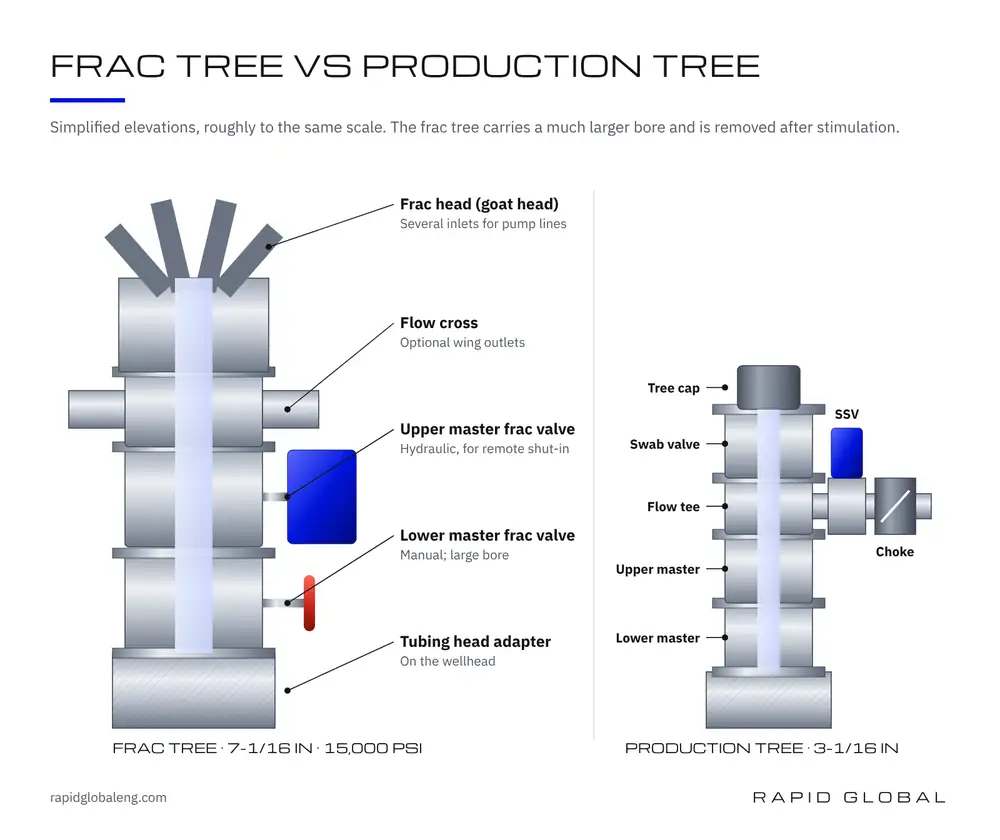
A well that is hydraulically fractured usually sees two different trees in its life. During stimulation it carries a frac tree, built to pump huge volumes of sand-laden fluid at high pressure. Once the well is completed, the frac tree is removed and a production tree is installed for years of controlled flow. They share the same principles, but almost every design choice differs.
What a frac tree does
A frac tree gives a straight, large bore from the frac pumps into the well, and enough valves to isolate the well safely between stages. It is temporary equipment, often rented, and it sees some of the harshest service in the oilfield: abrasive proppant at high velocity and repeated pressure cycles.
Typical features
- Large bore: commonly 5-1/8 in or 7-1/16 in, to keep velocity and erosion down at high pump rates.
- High pressure: usually 10,000 or 15,000 psi working pressure.
- Frac valves: two or more large gate valves stacked vertically, with at least one hydraulically actuated so the well can be shut in remotely.
- Frac head (goat head): a block on top with several inlets so multiple pump lines can feed one well.
- Zipper manifold: on multi-well pads, a manifold routes the frac spread from one well to the next without rigging down.
What a production tree does
A production tree controls flow from the well over its producing life. It has smaller bores, a choke to control rate, and a fail-safe surface safety valve. See What is a Christmas tree? for the full layout.
Typical features
- Smaller bore: commonly 2-1/16 in to 4-1/16 in, matched to the tubing.
- Master, wing and swab valves in a cross or tee arrangement.
- Surface safety valve on the wing, actuated and fail-safe closed.
- Choke to control flow rate and protect the reservoir; see how chokes work.
- Long design life, with material class chosen for the produced fluid.
Comparison
| Frac tree | Production tree | |
|---|---|---|
| Purpose | Stimulation, temporary | Production, long term |
| Bore | 5-1/8 or 7-1/16 in common | 2-1/16 to 4-1/16 in common |
| Working pressure | 10,000 to 15,000 psi | Matched to shut-in pressure |
| Main threat | Erosion from proppant, pressure cycles | Corrosion, long-term seal life |
| Flow control | Pumps control rate | Choke |
| Valves | Large gate valves, manual and hydraulic | Gate valves, SSV, choke |
Design and maintenance points for frac trees
- Erosion is the main wear mechanism. Valve gates, seats and bore transitions need regular inspection and are often hardfaced or coated.
- Grease is pumped into frac valve bodies between stages to keep sand out of cavities. Missed greasing is a common cause of valve failure.
- Pressure cycles from repeated stages drive fatigue in bodies and connections, so cycle counts matter for rental fleets.
- Frac trees are API 6A equipment and are usually specified at PSL 3 or higher; see API 6A PSL levels.
Frequently asked questions
Can a production tree be used for fracking?
Rarely. Its bore is too small and its valves are not designed for proppant at frac rates. Wells are usually fracked through a frac tree or a wellhead isolation tool.
What valves are on a frac tree?
Typically a lower master frac valve, an upper master frac valve that is often hydraulic, and sometimes a flow cross with wing valves, topped by a frac head. See gate valve types for how these valves seal.
Work with RAPID GLOBAL
RAPID GLOBAL designs, analyses and requalifies wellhead, subsea and valve equipment to API standards. If you need help with frac or production tree design and analysis, talk to an engineer.