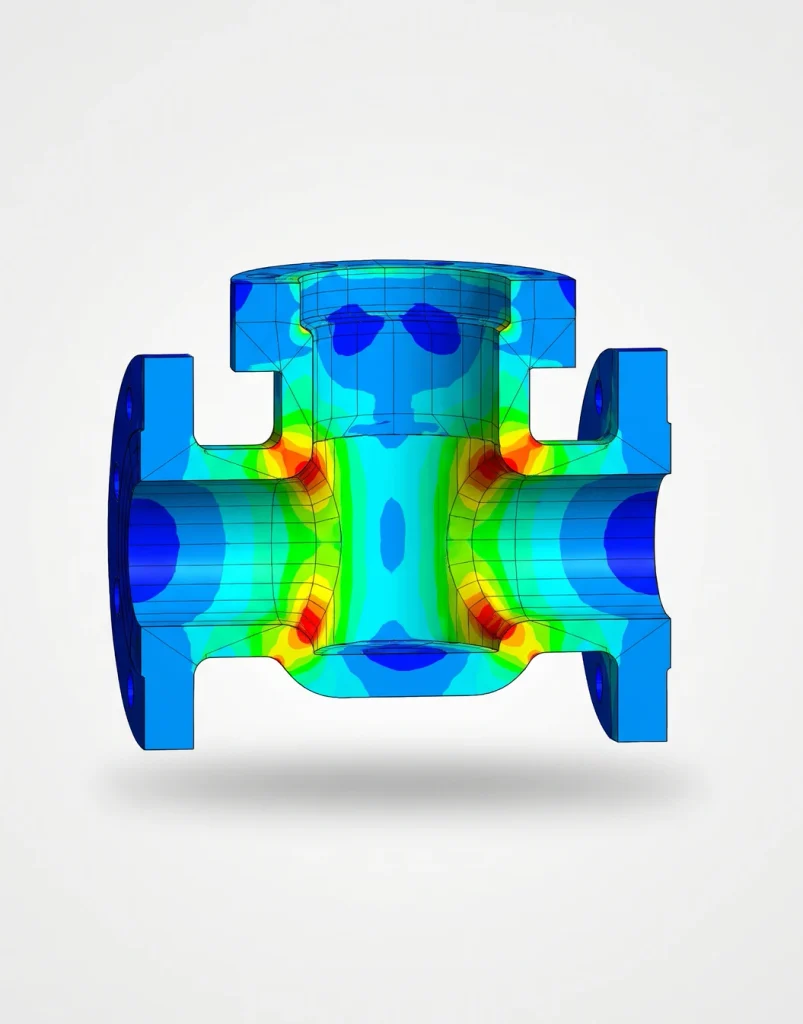
A choke’s job sounds simple — restrict flow — but the way it does that, and which type gets used where, has real engineering reasoning behind it. Here’s how choke valves actually work, and why a well might use a fixed choke instead of an adjustable one, or vice versa.
The basic principle
A choke creates a precisely sized restriction in the flow path, forcing fluid through a smaller opening than the surrounding piping. That restriction drops pressure and controls flow rate downstream. Done right, it also protects downstream equipment (separators, flowlines) from the well’s full shut-in pressure, and helps manage the producing rate to avoid problems like sand production, water or gas coning, or excessive drawdown on the reservoir.
Most producing wells operate their choke in critical (sonic) flow — fluid velocity through the restriction reaches the local speed of sound, which means downstream pressure changes can’t propagate back upstream through the choke. This is what makes choke-based rate control stable and predictable; see our Choke Bean Sizing calculator logic post for the math behind it.
Fixed (positive) chokes
A fixed choke uses a precisely machined bean — a disc or cylinder with a specific orifice size, specified in 64ths of an inch — installed in a choke body. The size can’t be changed while the well is flowing; changing rate means shutting in the well and physically swapping the bean. Fixed chokes are simple, robust, and cheap, which makes them well suited to stable, low-risk production wells where the rate doesn’t need to change often.
Adjustable chokes
An adjustable choke uses a variable-orifice mechanism — commonly a needle-and-seat or a rotating/sliding cage — that lets the operator change the effective flow area while the well is still flowing, either manually or via a hydraulic actuator. This is essential for well testing (where rate needs to be varied through several stages), for wells with changing reservoir conditions over time, and for any application needing remote or automated rate control. The tradeoff is more moving parts, more erosion-prone trim, and higher cost and complexity than a fixed bean.
Trim material: the part that actually wears out
Whichever type is used, the choke’s internals — the bean, cage, or needle and seat — are where erosion actually happens, especially in high-velocity, sand-laden, or high-GLR service. Tungsten carbide and Stellite trim are standard choices for erosion resistance in demanding service; the choke body itself is usually the less erosion-critical part, though it still has to hold full well shut-in pressure per API 6A.
Need to size a choke for a specific well? Try our Choke Bean Sizing calculator, or talk to an engineer about choke or manifold design.