A subsea Christmas tree does the same job as a surface tree: it controls flow out of the well, gives access to the bore and shuts the well in safely. The difference is that nobody can walk up to it. Every valve is remotely actuated, every part must survive decades on the seabed, and any intervention needs a vessel. That shapes almost every component.
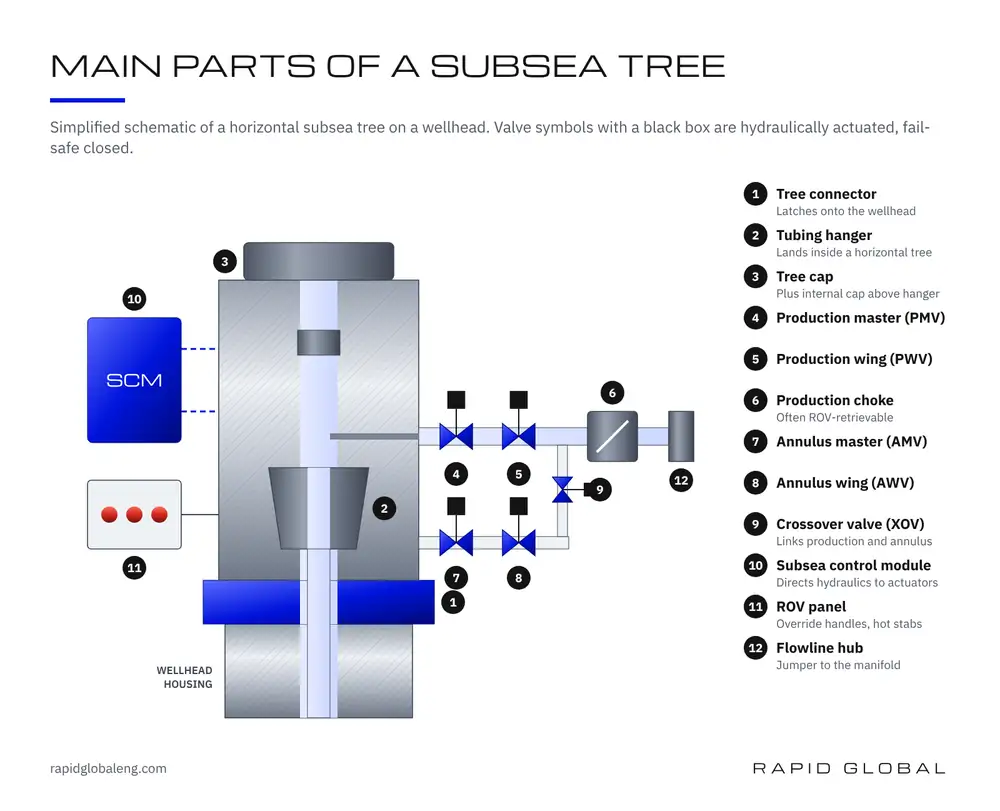
This guide walks through the main parts of a subsea tree, from the connector at the bottom to the control module on the side.
Vertical and horizontal trees
There are two main layouts, and they decide where several components sit.
- Vertical (conventional) tree: the tubing hanger lands in the wellhead, and the master valves are stacked vertically in the tree bore above it. The tree can be pulled without pulling the tubing.
- Horizontal tree: the tubing hanger lands inside the tree body, and the production valves sit on a horizontal side outlet. The tubing can be pulled through the tree without removing it, which suits wells that need frequent workovers.
Main components
Tree connector
A hydraulically locked connector latches the tree onto the subsea wellhead housing and seals with a metal gasket. It must carry the tree’s weight, pressure end load and bending from the riser or intervention stack during workover.
Production master and wing valves
The production master valve (PMV) is the first barrier on the production bore. The production wing valve (PWV) isolates the tree from the flowline. Both are fail-safe closed gate valves with hydraulic actuators. A spring closes them if control pressure is lost.
Annulus master and wing valves
The annulus valves (AMV and AWV) give controlled access to the tubing-casing annulus so it can be monitored, bled down or used for gas lift. On many trees the annulus is the only way to see whether the tubing or packer is leaking.
Crossover valve
A crossover valve (XOV) links the production and annulus circuits. It lets operators circulate fluids, for example to displace the well or to manage hydrates, without an intervention vessel.
Production choke
Most subsea trees carry an adjustable choke on the production outlet. It is often a retrievable insert so it can be changed by ROV without recovering the tree. For choke basics, see adjustable vs fixed chokes.
Tubing hanger
The hanger suspends the tubing and seals the annulus. On a subsea tree it also carries the penetrators for the downhole safety valve control line, chemical injection lines and gauge cables. See how a tubing hanger works.
Tree cap
The tree cap is a pressure barrier and debris cover on top of the tree bore. On horizontal trees an internal tree cap provides a second barrier above the tubing hanger plug.
Subsea control module and sensors
The subsea control module (SCM) receives power and signals through the umbilical and directs hydraulic fluid to each actuator. Pressure and temperature transmitters, sand detectors and valve position sensors report back to the host facility. The SCM is retrievable so electronics can be replaced without disturbing the tree.
ROV panel and flowline connection
An ROV panel provides override handles and hot stabs so a remotely operated vehicle can operate valves if the control system fails. The flowline or jumper connects to a hub on the tree’s production outlet.
What governs the design
Subsea trees are designed to API 17D / ISO 13628-4, which builds on API 6A requirements for valves, materials and testing. Typical ratings are 5,000, 10,000 or 15,000 psi. Water depth, external pressure, cathodic protection and the cost of intervention drive extra requirements. The API 6A vs API 17D post explains how the two standards relate.
Frequently asked questions
What is the difference between a subsea tree and a surface tree?
The subsea tree adds remote actuation, a hydraulic connector, ROV interfaces and a control module, and is designed for no routine access. See subsea vs surface tree design differences.
How many valves does a subsea tree have?
It depends on the design, but a typical production tree has at least six main valves: PMV, PWV, AMV, AWV, crossover and one or more chemical injection valves, plus the choke.
Work with RAPID GLOBAL
RAPID GLOBAL designs, analyses and requalifies wellhead, subsea and valve equipment to API standards. If you need help with subsea tree or connector design and analysis, talk to an engineer.