
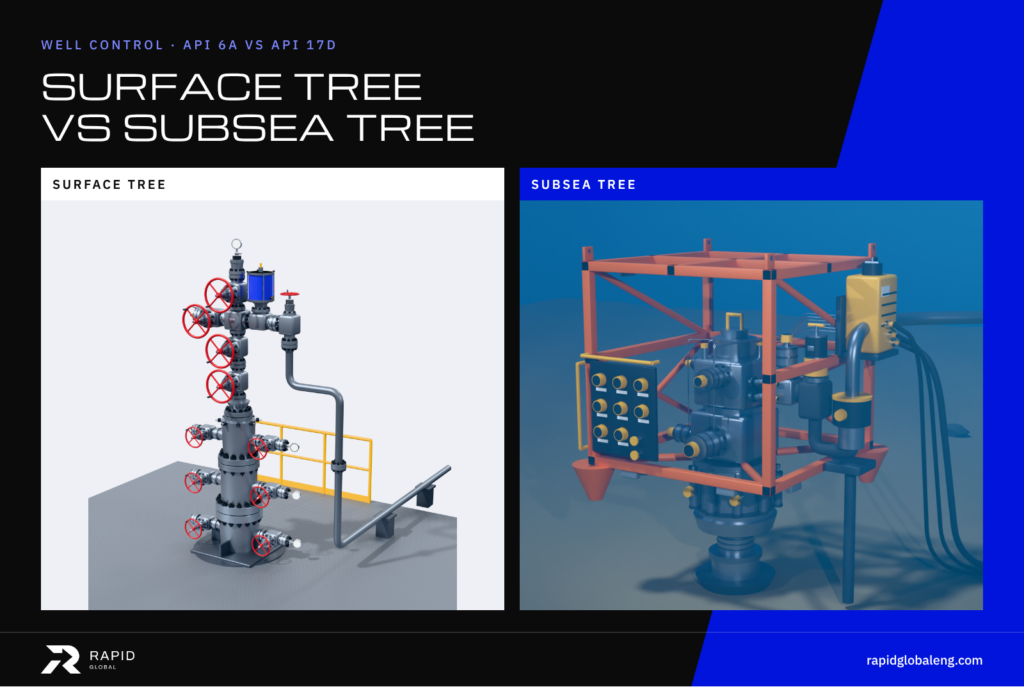
A Christmas tree does the same job wherever it sits: it controls the well. What changes is who can reach it, and what it costs when something goes wrong. One tree is worked by hand on a platform deck or a well pad. The other sits on the seabed and is run entirely by hydraulics, electrics and ROVs. This guide compares the two, side by side, so you can see why their designs diverge.
This is the visual guide. For the full written explanations, see What Is a Christmas Tree in Oil and Gas? Surface vs. Subsea Explained and Subsea Tree vs. Surface Tree: Key Design Differences Engineers Should Know.
What every Christmas tree does
Surface or subsea, the tree has three jobs:
- Hold the well. The master valves in the bore are the barriers between the reservoir and the outside world.
- Route the flow. The wing valve and choke send production to the flowline at a set rate.
- Give access. The swab valve opens the bore for wireline tools, and a kill wing lets fluid in.

The surface (dry) tree: built to be worked by hand
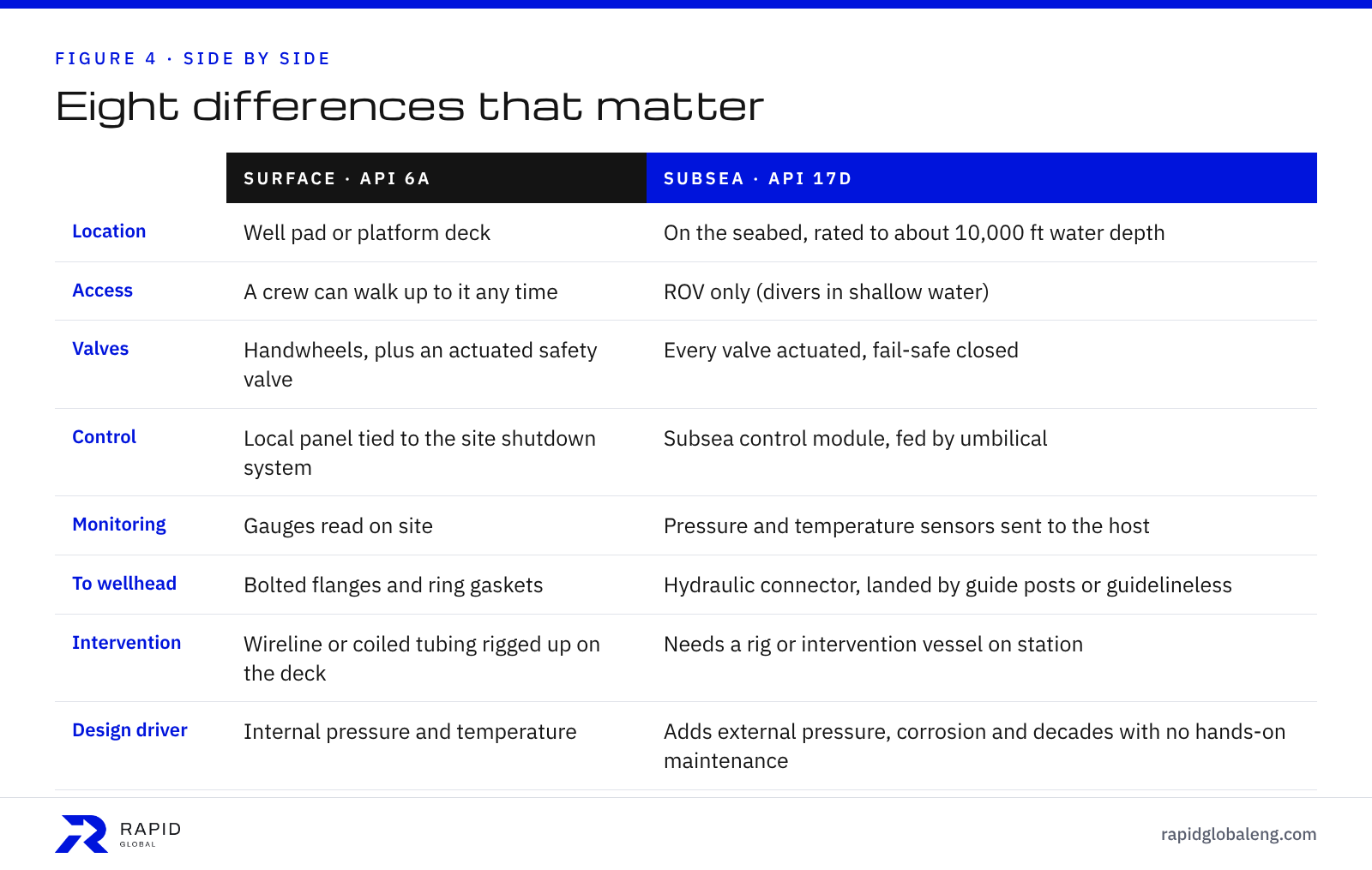
A surface tree is built to API 6A and bolts straight onto the wellhead with flanges and ring gaskets. Rated working pressures run from 2,000 to 20,000 psi, matched to the flanges. A crew can walk up to it at any time: handwheels open and close the manual valves, an actuated surface safety valve on the production wing fails closed, and gauges are read on site. Wireline and coiled tubing rig up directly on the tree.
Because every valve is within reach, the design priority is internal pressure and temperature. A valve that will not seal becomes a work order, and a crew can be on site the same week.

The subsea (wet) tree: built never to be touched
A subsea tree is built to API 17D and sits on the seabed, rated to about 10,000 ft of water depth. Nobody walks up to it. Access is by ROV only (divers in shallow water). Every valve is actuated and fails safe closed. A subsea control module, fed by an umbilical, opens and closes the valves, and pressure and temperature sensors send data back to the host. The tree locks onto the wellhead with a hydraulic connector, landed by guide posts or guidelineless. The orange frame protects it from snags and impacts, and the ROV panel carries the override buckets and hot stabs for manual intervention.
Intervention needs a rig or an intervention vessel on station. So the design has to add external pressure, corrosion and decades with no hands-on maintenance to the internal pressure and temperature loads a surface tree already sees. A subsea tree can weigh more than 150,000 lb, and lead times run to about a year.

Eight differences that matter
Vertical or horizontal? A subsea-only choice
Surface trees are all vertical. Subsea, the choice comes down to where the tubing hanger sits, and that decides what you can pull without the other.
| Vertical tree (VXT) | Horizontal tree (HXT) | |
|---|---|---|
| Tubing hanger | Lands in the wellhead, below the tree | Lands inside the tree body |
| Valves | Master and swab stacked in the vertical bore | Flow leaves sideways; valves sit off the bore |
| Run order | Completion first, then the tree | Tree first, then the completion through it |
| Workover | The tree comes off before the tubing can be pulled; the tree can be swapped without pulling tubing | Tubing is pulled through the tree, which stays hooked up to the flowline and umbilical |
| Suits | Wells that rarely need the completion pulled | Large-bore completions, ESPs and frequent workovers |
Ratings and limits
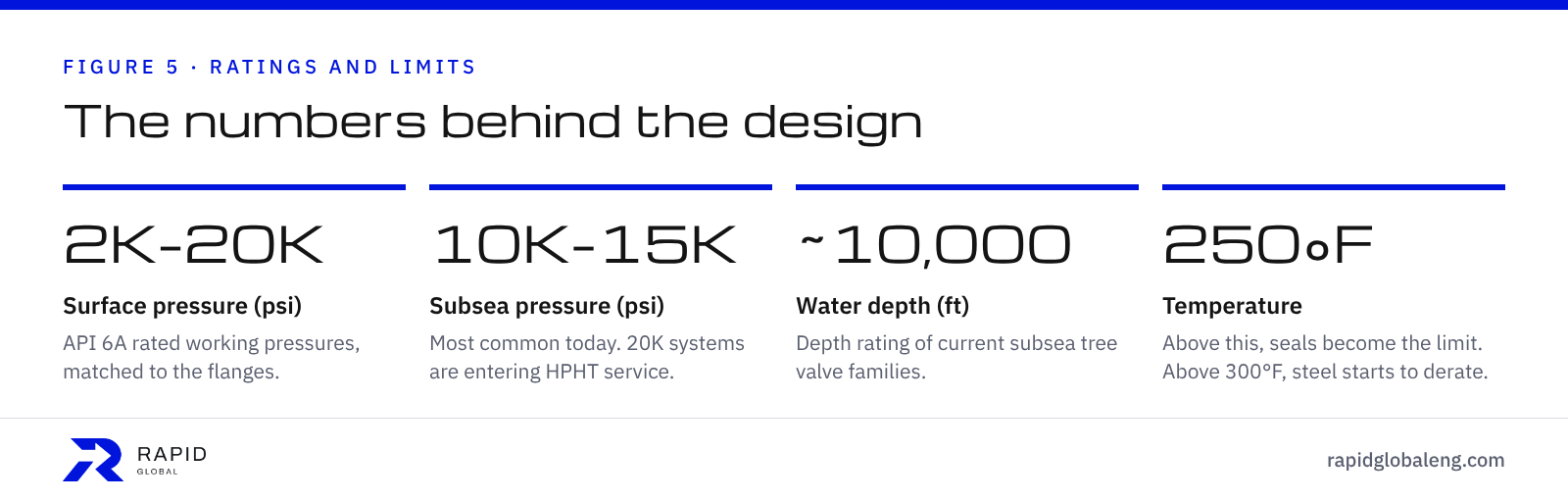
Two trends are worth watching. 20K deepwater: Chevron’s Anchor field (2024) is the first deepwater 20K development, in about 5,000 ft of water with wellhead pressures up to 17,000 psi. All-electric trees: Total’s K5F field in the North Sea (2008) proved that trees can run with no hydraulics at all, so there are no fluid leaks and no fluid to dispose of.
The takeaway: same barriers, very different cost of getting it wrong
- On the surface, a valve that will not seal is a work order and a crew on site the same week.
- On the seabed, the same fault means a vessel, an ROV spread and lost production while you wait.
- So the design work moves upstream. Tolerances, seal selection, FEA and qualification testing have to be right before the tree leaves the shop.
Related reading
- What Is a Christmas Tree in Oil and Gas? Surface vs. Subsea Explained
- Subsea Tree vs. Surface Tree: Key Design Differences Engineers Should Know
Designing or upgrading tree and wellhead equipment?
RAPID GLOBAL provides wellhead, Christmas tree and valve engineering, with CAD and FEA to API 6A and API 17D. Our team has decades of experience at Cameron and TechnipFMC and has supported clients such as ADNOC, Aramco and PDO Oman. Talk to an engineer: sales@rapidglobaleng.com.

