
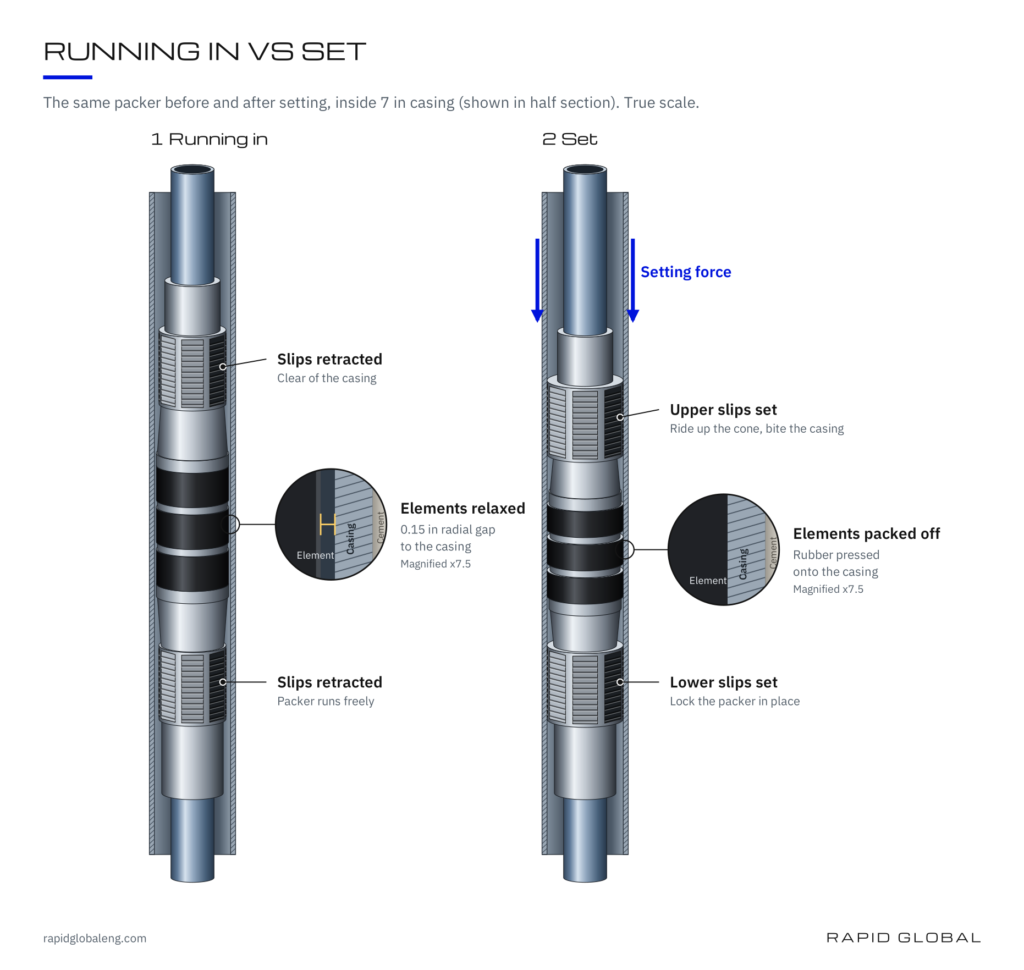
A packer is a downhole tool that seals the gap between the production tubing and the casing. That gap is called the annulus. Once the packer is set, well fluids and pressure stay inside the tubing, and the casing above the packer is isolated from the reservoir.
Almost every modern completion uses at least one packer. This guide covers what packers do, how they are built, the main types and what to consider when choosing one.
What does a packer do?
The main job is isolation. A packer separates the annulus from the producing zone so the well can be produced, injected or tested in a controlled way. That single seal delivers several benefits:
- Protects the casing. Corrosive fluids such as H2S, CO2 and brine stay inside the tubing instead of attacking the casing wall.
- Holds pressure off the casing. High reservoir or injection pressure is carried by the tubing and packer, not the full casing string.
- Isolates zones. Multiple packers let one well produce, inject or shut off separate intervals.
- Keeps well control in the tubing. Combined with a subsurface safety valve, the packer forms part of the well barrier.
- Stabilises the tubing. It anchors the string and limits movement caused by pressure and temperature changes.
- Supports artificial lift. Gas lift, for example, needs a sealed annulus so injected gas enters the tubing only through the lift valves.
Main parts of a packer
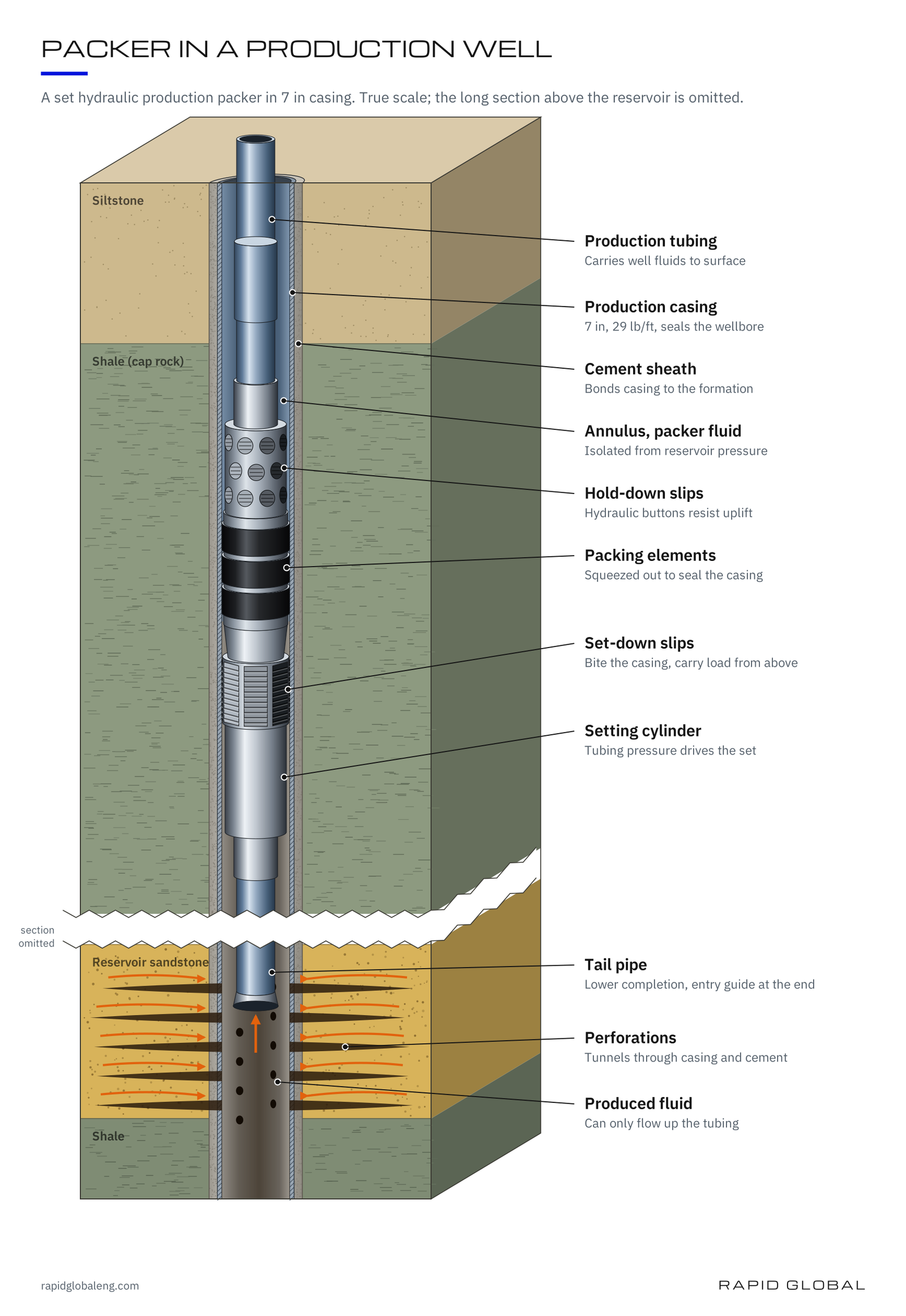
Most packers share the same basic building blocks, whatever their setting method.
| Part | What it does |
|---|---|
| Mandrel (body) | The central tube that carries flow and connects to the tubing above and below |
| Slips | Toothed, wedge-shaped segments that bite into the casing wall to anchor the packer |
| Cones | Tapered ramps that push the slips outward when the packer is compressed |
| Packing element | Elastomer rings squeezed outward against the casing to form the seal |
| Back-up rings | Metal or composite rings that stop the element extruding under high pressure |
| Setting and release mechanism | Shear pins, ratchets, J-slots or pistons that lock the packer set and, on retrievable designs, let it release |
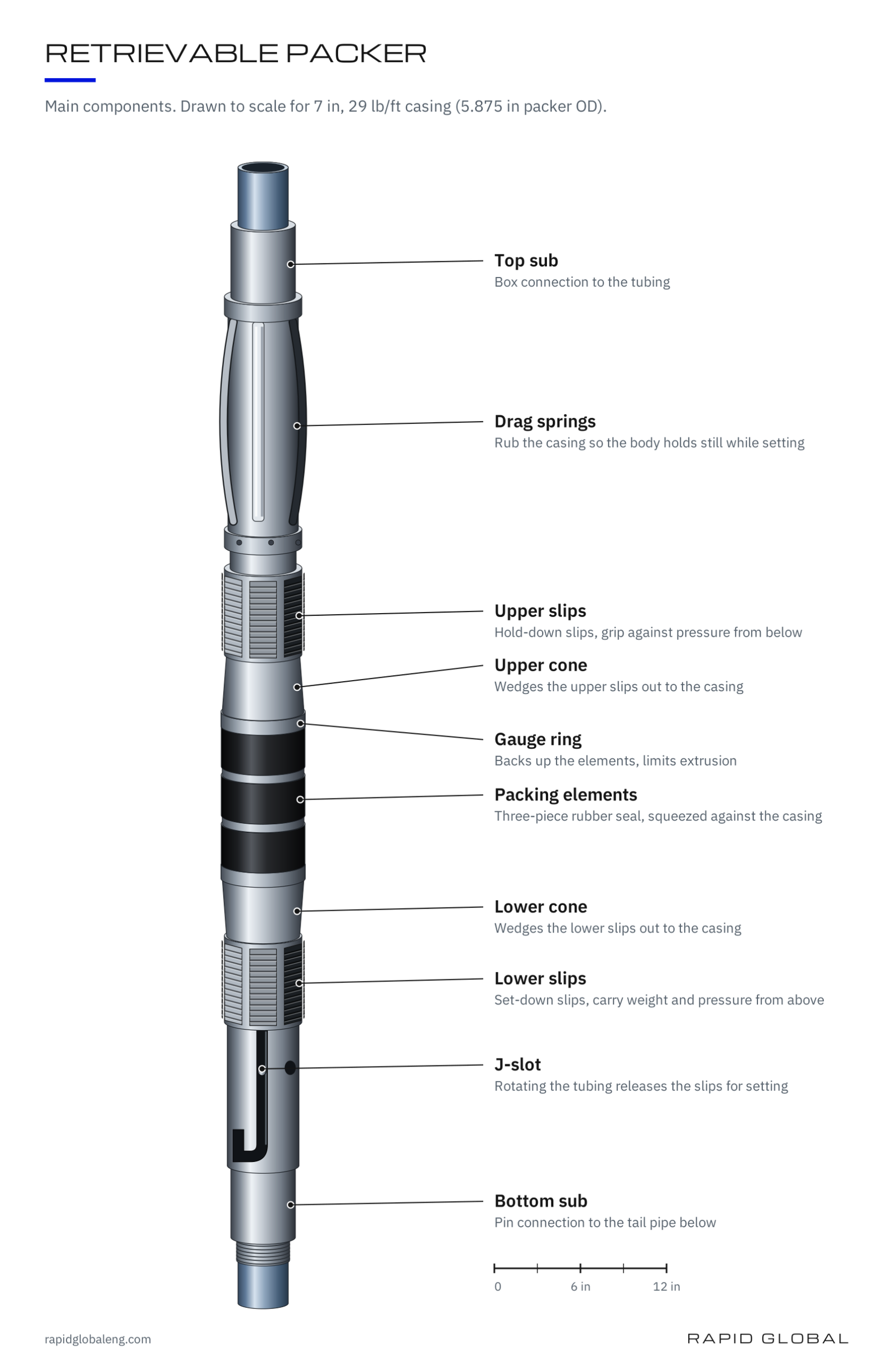
Packers with slips on both sides of the element (bi-directional slips) hold pressure from above and below. That is the norm for production packers.
How a packer sets
- The packer is run in the well on tubing, drill pipe, wireline or coiled tubing to the planned depth.
- A setting force is applied: tubing weight, pull, rotation, hydraulic pressure or a wireline setting tool.
- The cones drive the slips out until their teeth grip the casing.
- Continued force compresses the packing element until it seals against the casing wall.
- A lock ring or ratchet holds the packer in the set position so it stays sealed once the setting force is removed.
Permanent vs retrievable packers
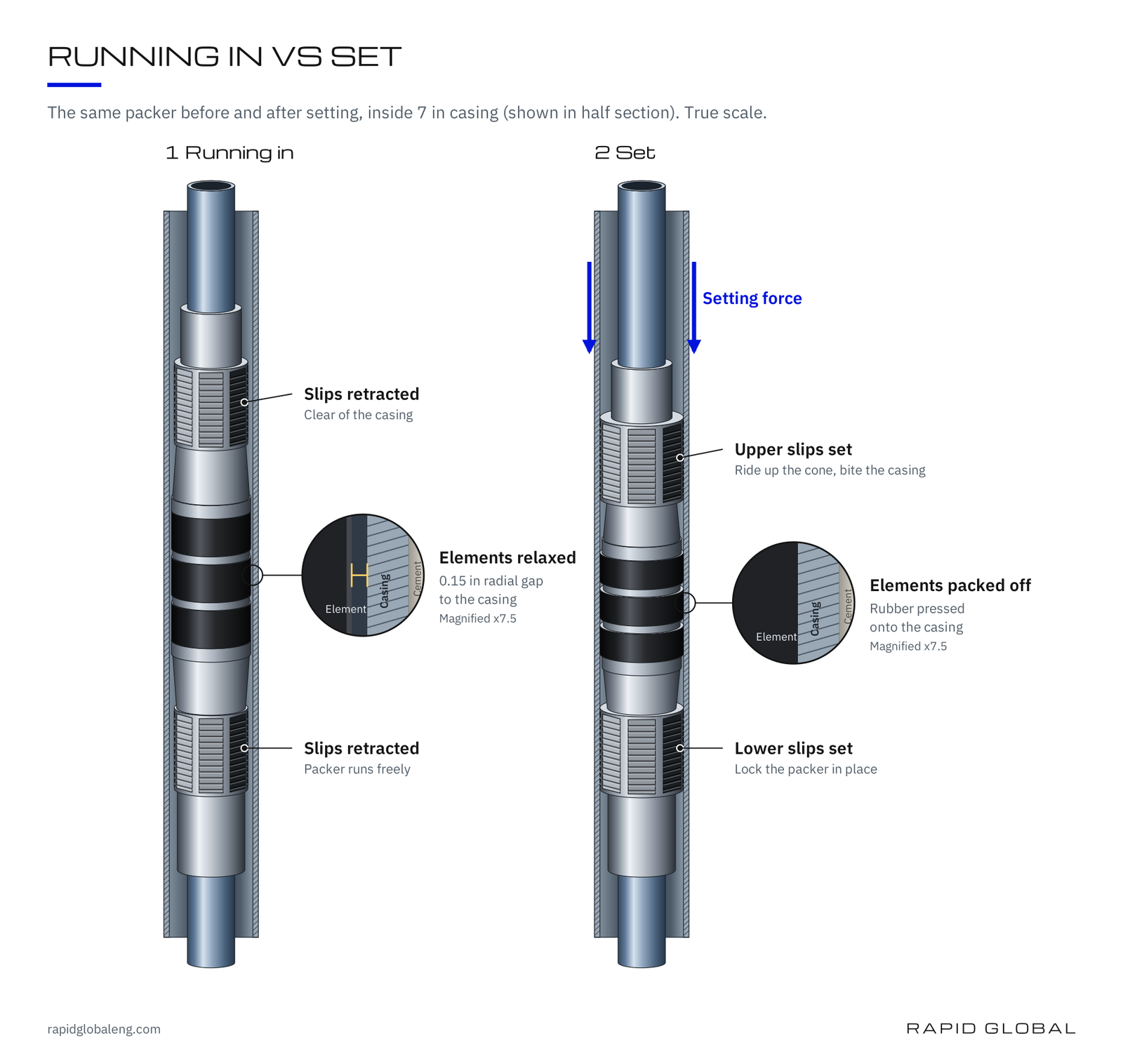
The first way packers are classified is by how they come out of the well.
| Permanent packer | Retrievable packer | |
|---|---|---|
| Removal | Milled out | Released and pulled on tubing or workstring |
| Pressure and temperature rating | Typically highest | Usually lower than an equivalent permanent design |
| Bore | Large bore for its casing size | Often smaller bore |
| Typical use | Long-life production and injection wells, HPHT and sour wells | Temporary completions, testing, treating, wells expecting frequent workovers |
| Workover impact | Tubing can often be pulled from a seal bore while the packer stays in place | The whole packer is recovered and can be redressed |
A third group, permanent-retrievable packers, aims to combine both. These designs are built for permanent-style performance but can be released with a dedicated retrieving tool instead of a milling job.
How packers are set: the main methods
- Mechanical, compression (weight) set. Slacking off tubing weight compresses the element. Simple, but the packer can unset if the tubing shortens.
- Mechanical, tension set. Pulling up on the tubing sets the packer. Common in shallow wells and injection wells where tubing tends to lengthen.
- Mechanical, rotation set. A J-slot or right-hand turn releases the slips and lets weight or tension set the tool.
- Hydraulic set. Pressure applied down the tubing, against a plug or ball seat, drives a setting piston. No tubing manipulation is needed, which suits deviated wells and multi-packer completions.
- Hydrostatic set. The packer uses the well’s own hydrostatic pressure, released by a trigger, to supply the setting force.
- Wireline set. An electric-line setting tool sets the packer precisely on depth, then the tubing is run and stung into it.
- Inflatable. An elastomer bladder is inflated with fluid. Inflatables can pass through restrictions and seal in larger or irregular holes, including open hole.
Other common packer types
- Production packers seal the annulus for the producing life of the well.
- Injection packers isolate water or gas injection zones and are built to handle cooling and tubing movement.
- Dual-string packers seal around two tubing strings to produce two zones separately.
- Seal-bore packers have a polished bore that accepts a seal assembly, so tubing can be pulled without disturbing the packer.
- Isolation and test packers are retrievable tools used for squeeze cementing, stimulation and pressure testing.
- Swell packers use an elastomer that swells in oil or water to seal, with no mechanical setting at all.
Packer standards: API 11D1
Packers and bridge plugs are covered by API Specification 11D1, which is aligned with ISO 14310. It defines validation grades from V6 to V0.
| Grade | What is proven |
|---|---|
| V0 | Gas test with axial loads and temperature cycling, zero bubble leak allowed |
| V1 | Gas test with axial loads and temperature cycling, small defined leak allowed |
| V2 | Gas test with axial loads |
| V3 | Liquid test with axial loads and temperature cycling |
| V4 | Liquid test with axial loads |
| V5 | Liquid test at maximum casing ID and temperature, with pressure reversals |
| V6 | Supplier-defined performance |
A higher grade covers the requirements of every lower one. The standard also sets quality-control grades for manufacturing and inspection. For gas wells and HPHT service, operators usually specify V0 or V1.
How to choose a packer
Selection starts from the well’s load cases, not the catalogue. Key points to check:
- Casing size, weight and grade, which fix the packer OD and the slip load the casing must carry
- Maximum differential pressure from above and below, and the operating temperature range
- Produced or injected fluids, which drive elastomer choice and metallurgy for H2S and CO2
- Tubing movement from pressure and temperature changes, and whether the packer must anchor the tubing or allow it to move
- Required bore for flow, wireline tools and future interventions
- Well deviation and the setting method that will work at that depth
- The intervention plan: will the packer stay for the life of the well or need to come out?
- The validation grade required by the operator’s well barrier policy
A packer that is right on paper still needs a check against its rating envelope. That envelope plots the combined pressure and axial load the packer can carry, and every load case should fall inside it.
Frequently asked questions
What is the difference between a packer and a bridge plug?
A packer seals the annulus and lets flow pass through its bore. A bridge plug has no through-bore and shuts off the whole wellbore below it.
How long does a production packer stay in the well?
A permanent production packer is usually designed to stay for the life of the completion, often decades.
What is a packer’s rating envelope?
It is the manufacturer’s chart of the combined differential pressure and tension or compression the packer can withstand.
Can a packer be reused?
Retrievable packers can be pulled, redressed with new elastomers and slips, and run again. Permanent packers are destroyed when milled.
Work with RAPID GLOBAL
RAPID GLOBAL’s engineers have decades of downhole and wellhead experience from Cameron and TechnipFMC. We support operators and service companies with packer specification, load-case and rating-envelope checks, FEA of packer components, and design to API 11D1. Send us your specification or drawing and we will tell you what it would take.