Every API 6A flange seals with a solid metal ring that sits in machined grooves in both flange faces. There are three ring families, R, RX and BX, and fitting the wrong one is one of the most common causes of a leak at first pressure test.
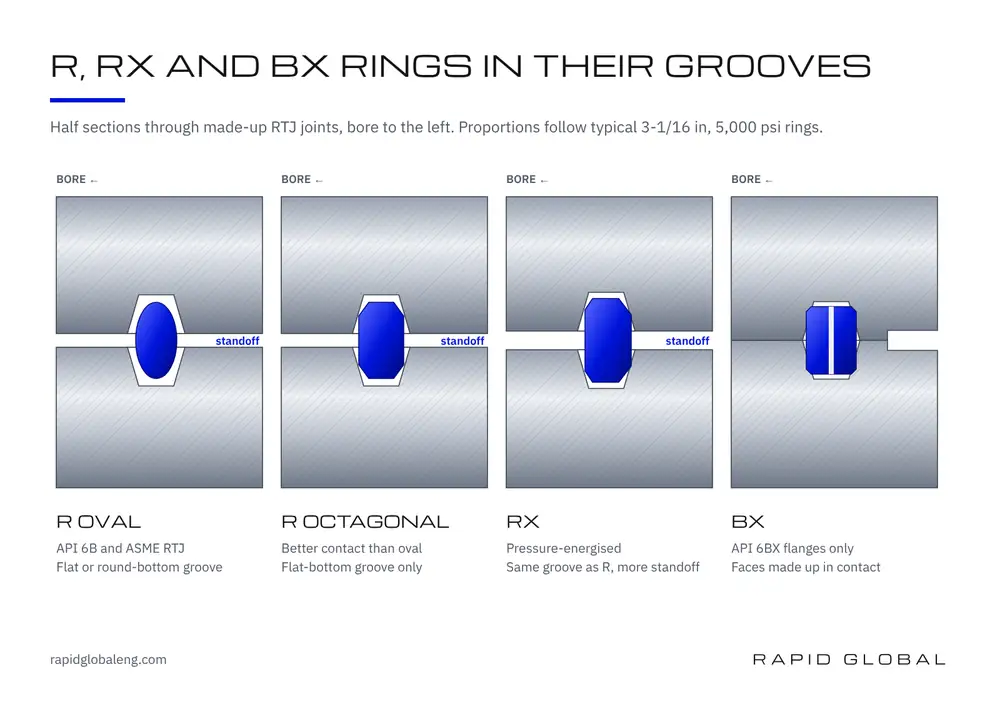
This guide explains how each ring seals, which flanges take which ring, and the mistakes to avoid on the rig floor.
How a ring joint seals
A ring joint is a metal-to-metal seal. Bolt load drives the ring into the tapered groove until the ring’s flanks yield slightly and conform to the groove walls. That gives two continuous line seals, one on each side of the ring. The ring has to be softer than the groove, so the ring deforms and the flange does not.
R rings: oval and octagonal
The R ring is the original design. It comes in two profiles:
- Oval fits both older round-bottom grooves and modern flat-bottom grooves.
- Octagonal gives better contact and sealing efficiency, but fits flat-bottom grooves only.
R rings rely on bolt load alone. The flange faces never touch, so a gap called the standoff remains all the way round the joint. They are used in API 6B flanges and in ASME B16.5 RTJ flanges.
RX rings: pressure-energised
An RX ring fits the same groove as the R ring with the same number, but its section is taller and its outer flanks are shaped so line pressure pushes them harder into the groove. The higher the pressure, the tighter the seal. That makes RX the preferred ring for API 6B flanges at 2,000, 3,000 and 5,000 psi. Because the ring is taller, the standoff is larger than with an R ring.
BX rings: for 6BX flanges only
BX rings are used on API 6BX flanges, which cover 5,000 psi in the larger bores and everything from 10,000 to 20,000 psi. A BX ring has a near-square section and a small vent hole through it to balance pressure on both sides. The flanges are made up face to face. Once the raised faces touch, extra bolt load goes into the faces rather than the ring, which makes the joint stiffer against bending.
A BX ring never fits an R or RX groove, and the reverse is also true.
Quick selection guide
| Flange | Ring to use | Joint make-up |
|---|---|---|
| API 6B, 2,000 to 5,000 psi | RX (R permitted) | Standoff gap remains |
| API 6BX, 5,000 to 20,000 psi | BX of the stamped number | Faces in contact |
| ASME B16.5 RTJ | R octagonal (oval for round-bottom grooves) | Standoff gap remains |
Always read the ring number stamped on the flange rim. One trap catches people often: a 13-5/8 in 5,000 psi flange takes BX-160, while the same bore at 10,000 psi and above takes BX-159.
Common mistakes
- Reusing a ring. A ring deforms plastically the first time it is made up and will not seal reliably again.
- Fitting a ring harder than the groove. It coins the groove and damages the seat for every future ring.
- Uneven bolt-up. On 6B joints, check the standoff at four or more points; a tapered gap means uneven ring loading.
- Wire-brushing the groove. Clean sealing surfaces with solvent and a non-metallic brush only.
Frequently asked questions
Can I use an RX ring in an R groove?
Yes, if the numbers match. RX rings are designed to fit the R groove of the same number. Expect a larger standoff.
Why does a BX ring have a hole in it?
The vent hole balances pressure across the ring so pressure trapped between the ring and the groove cannot prevent the faces from closing.
What material should the ring be?
Soft iron or low-carbon steel for carbon steel grooves in general service. For corrosive or sour service, grooves are usually inlaid with a corrosion-resistant alloy and the ring material is matched to the inlay.
For ring number tables, material hardness limits and a torque table, download our free Ring Gaskets & Flanges Handbook. To work out flange bolt torque, try our flange bolt torque calculator.
Work with RAPID GLOBAL
RAPID GLOBAL designs, analyses and requalifies wellhead, subsea and valve equipment to API standards. If you need help with flange or ring joint design, talk to an engineer.