
Before any API 6A pressure-containing part leaves the factory, it is filled with water and pressurised above its rating. This hydrostatic body test, or shell test, proves the body has no leaks and no gross defects. It is the most basic test in the standard and every PSL includes it.
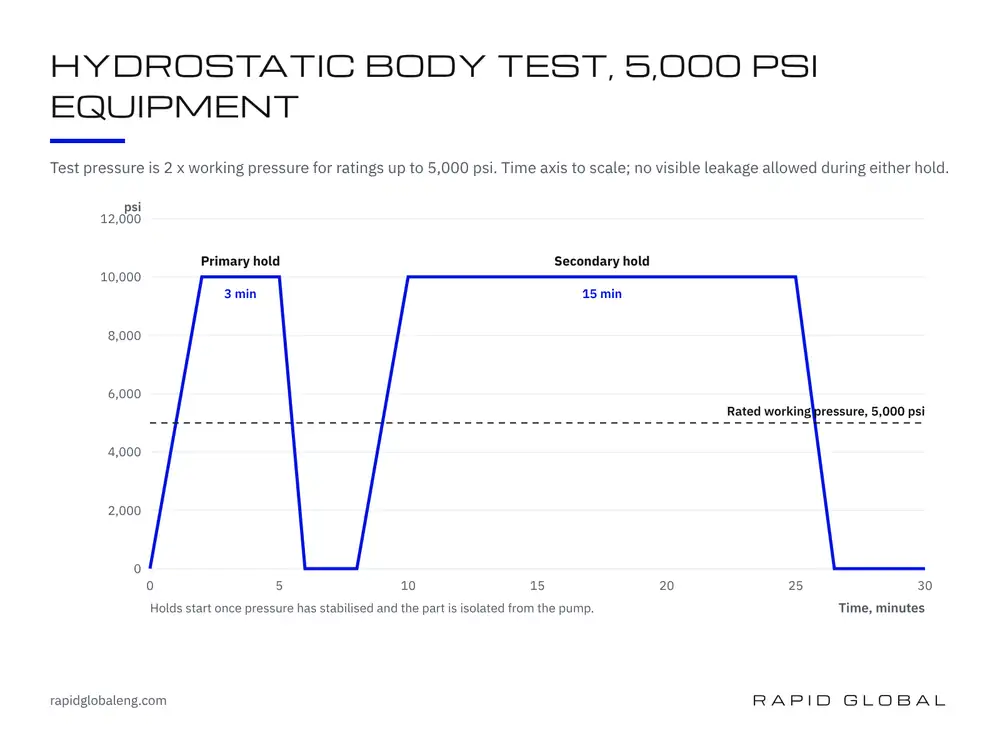
Test pressure
| Rated working pressure, psi | Body test pressure, psi |
|---|---|
| 2,000 | 4,000 |
| 3,000 | 6,000 |
| 5,000 | 10,000 |
| 10,000 | 15,000 |
| 15,000 | 22,500 |
| 20,000 | 30,000 |
Equipment rated up to 5,000 psi is tested at twice its working pressure. Equipment rated 10,000 psi and above is tested at 1.5 times its working pressure.
The test sequence
- Fill the part with water, venting all air.
- Raise pressure to the test value and isolate the part from the pump.
- Primary hold: at least 3 minutes, timed once pressure has stabilised.
- Bleed pressure to zero.
- Secondary hold: raise to test pressure again and hold for at least 15 minutes.
Higher PSLs and some company specifications call for longer holds and chart recorders.
Acceptance
There must be no visible leakage during either hold. The pressure gauge or recorder must also show no drop beyond the allowed tolerance. Water is used because it stores very little energy when compressed, so a failure releases far less energy than it would with gas.
Body test vs seat test vs gas test
- Body test: checks the shell. Valves are tested part-open so the whole cavity sees pressure.
- Seat test: checks that a closed valve seals across its seats, at working pressure.
- Gas test: for PSL 3G and above, done with gas, which finds leaks that water can miss.
Frequently asked questions
Why is the test above working pressure?
To prove a margin of strength over the rating and to show up casting or forging defects that might not leak at normal pressure.
Can a part be retested after repair?
Yes. Any repair to a pressure-containing part means the hydrostatic test is repeated.
For what a pressure rating means, see What does MAWP mean?.
Work with RAPID GLOBAL
RAPID GLOBAL designs, analyses and requalifies wellhead, subsea and valve equipment to API standards. If you need help with pressure testing or requalification, talk to an engineer.

