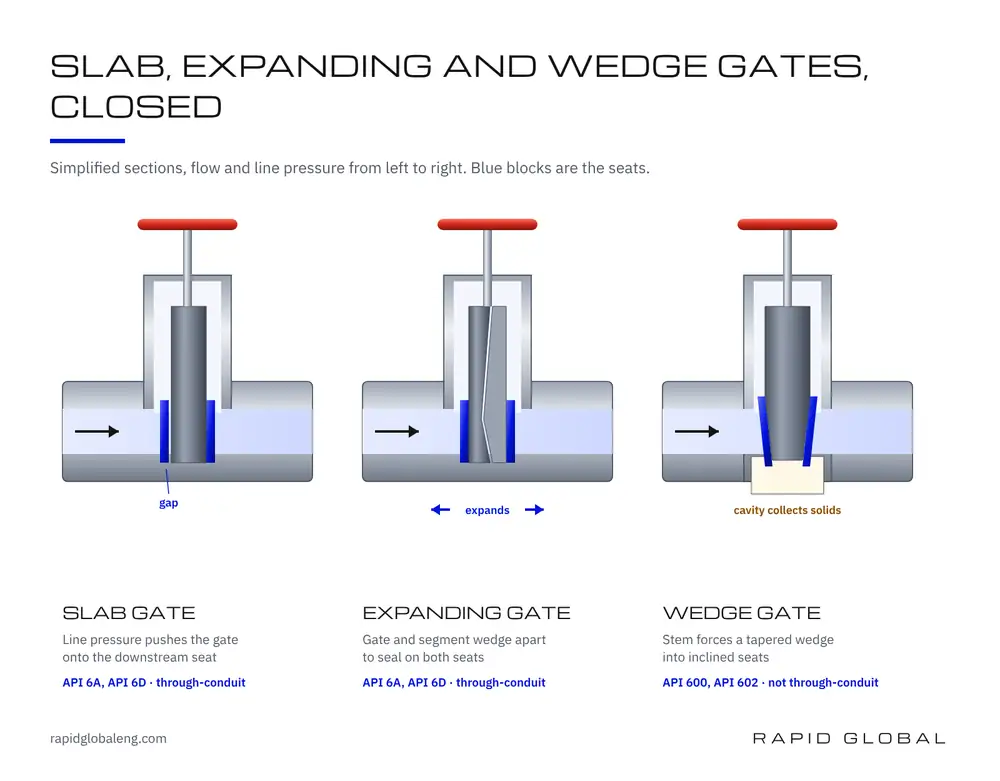
All gate valves close by moving a gate across the bore, but the way the gate seals against its seats differs a lot. Choosing the wrong type can mean a valve that leaks at low pressure, cannot be pigged, or wears out quickly in sandy service. The three main types in oil and gas are the slab gate, the expanding gate and the wedge gate.
Slab gate valves
A slab gate is a single flat plate with a hole through it. When the valve is open, the hole lines up with the bore, giving a full, smooth through-conduit. When closed, line pressure pushes the gate against the downstream seat to make the seal.
- Where used: API 6A Christmas trees and manifolds, and API 6D pipelines.
- Strengths: simple, few parts, full bore when open, and good tolerance of sand because the gate wipes the seat faces.
- Limits: the seal relies on line pressure, so sealing at very low pressure depends on the seat springs and seat design.
Most surface tree valves are slab gates. Our API 6A gate valve guide describes the parts in detail.
Expanding gate valves
An expanding gate has two parts: a gate and a segment with matching angled faces between them. As the valve reaches fully closed or fully open, the stem drives the parts against each other and the wedge action pushes them outward against both seats.
- Where used: wellhead and tree valves, pipeline block valves and services needing a tight seal at low pressure.
- Strengths: the seal is mechanical, so it holds even with no line pressure, and it seals against upstream and downstream seats at the same time. That makes double block and bleed possible in one valve.
- Limits: more parts and more complex to repair. Solids trapped between the gate and segment can affect operation.
Wedge gate valves
A wedge gate is tapered and seats between two inclined seats. The stem forces the wedge down into the seats to seal. Wedges come in solid, flexible and split versions; the flexible wedge allows for seat distortion from thermal or pipe loads.
- Where used: refinery, process and utility piping, usually to API 600 or API 602.
- Strengths: robust, widely available and inexpensive in many sizes.
- Limits: not through-conduit. A cavity under the wedge collects solids, and the bore cannot be pigged. They are rarely used on wellheads.
Comparison
| Slab | Expanding | Wedge | |
|---|---|---|---|
| Sealing force | Line pressure | Mechanical wedge action | Stem thrust |
| Seals on | Downstream seat | Both seats | Both seats |
| Through-conduit | Yes | Yes | No |
| Low-pressure sealing | Depends on seat design | Good | Good |
| Typical standard | API 6A, API 6D | API 6A, API 6D | API 600, API 602 |
Rising and non-rising stems
Separately from the gate type, the stem may rise as the valve opens, giving a visible position indicator, or turn in place inside a threaded gate. Most API 6A manual gate valves use a non-rising stem with a position indicator, which keeps the valve height short and the stem threads out of the weather.
Frequently asked questions
Which gate valve type is best for a Christmas tree?
Slab or expanding gate valves, both through-conduit. The choice usually comes down to the operator’s experience and whether low-pressure sealing is critical.
How does a gate valve compare with a ball valve?
See our gate valve vs ball valve comparison.
Work with RAPID GLOBAL
RAPID GLOBAL designs, analyses and requalifies wellhead, subsea and valve equipment to API standards. If you need help with gate valve design, FEA or requalification, talk to an engineer.