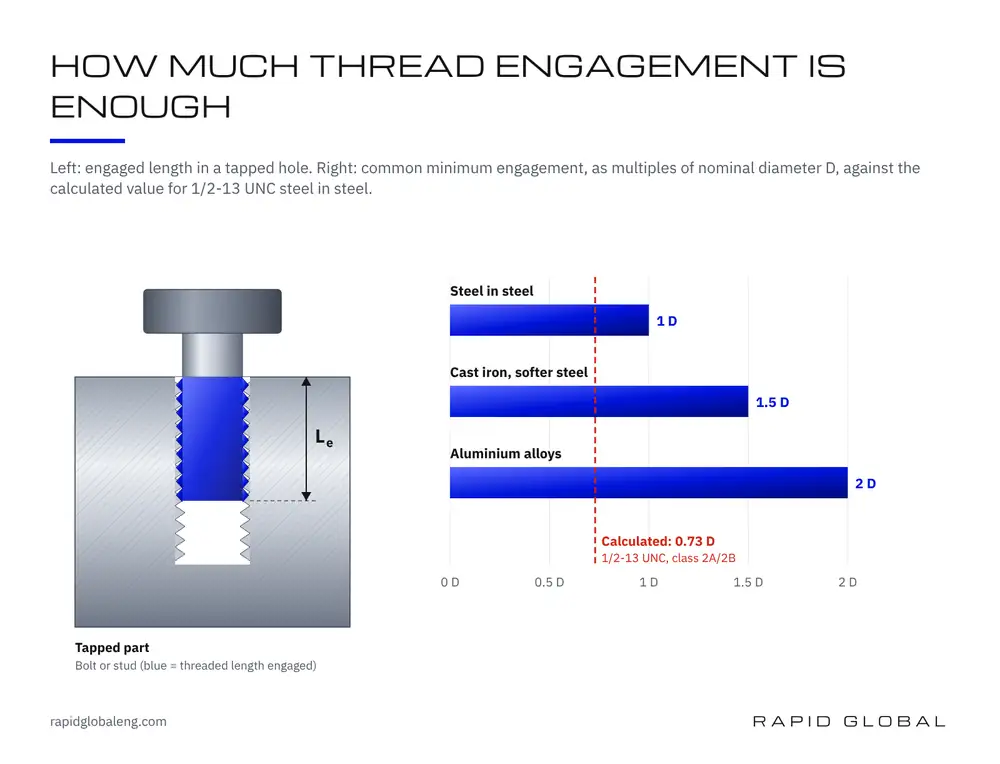
Thread engagement length is how far a bolt or stud is threaded into a nut or tapped hole. Too little and the threads strip before the bolt reaches its full strength. Too much adds cost and machining time without adding strength, because the first few threads carry most of the load anyway.
The goal is simple: the bolt should break in tension before the threads strip. A broken bolt is visible and easy to replace; stripped threads in a valve body or flange are not.
Rules of thumb
For standard unified inch threads, these minimum engagements are widely used:
| Tapped material | Minimum engagement |
|---|---|
| Steel nut or steel tapped hole of similar strength to the bolt | 1 x nominal diameter |
| Cast iron, or softer steel | 1.5 x nominal diameter |
| Aluminium alloys | 2 x nominal diameter |
These include a margin. When the design is tight, or the joint is critical, calculate it.
The engagement formula
For an internal thread at least as strong as the external one, the length of engagement needed to develop the full tensile strength of the bolt is:
Le = 2 At / [ π Kn,max ( 1/2 + 0.57735 n ( Es,min − Kn,max ) ) ]
- At is the tensile stress area of the bolt, in².
- Kn,max is the maximum minor diameter of the internal thread, in.
- Es,min is the minimum pitch diameter of the external thread, in.
- n is threads per inch.
The formula comes from setting the shear area of the stripped threads equal to twice the tensile stress area. Shear strength is roughly half tensile strength, so the threads and the bolt then fail at about the same load. Our unified thread calculator gives the pitch and minor diameters you need.
Worked example: 1/2-13 UNC, class 2A/2B
- At = 0.1419 in²
- Kn,max = 0.434 in (2B internal thread)
- Es,min = 0.4435 in (2A external thread)
- n = 13
0.57735 × 13 × (0.4435 − 0.434) = 0.0713, so the bracket is 0.5713.
Le = 2 × 0.1419 / (π × 0.434 × 0.5713) = 0.364 in, about 0.73 times the diameter.
That is why one diameter of engagement in a steel nut of matching strength is comfortably enough.
When the tapped part is weaker
If the tapped material has a lower tensile strength than the bolt, the internal threads strip first. Increase the engagement by the ratio J:
J = (As,ext × Sut,ext) / (An,int × Sut,int)
where As,ext and An,int are the shear areas of the external and internal threads, and Sut are the tensile strengths. If J is greater than 1, multiply Le by J. This is the case for steel studs in aluminium housings, or high-strength B7 studs in softer castings.
Practical points
- Ignore the first incomplete threads at a chamfer or countersink when measuring engagement.
- Do not count threads beyond the point where the bolt stops; blind holes need extra drill depth below the tapped length.
- Fine threads need more care: they have more shear area per inch but are more sensitive to tolerances.
- For studs in API 6A flanges, follow the stud lengths in the standard rather than a rule of thumb.
Frequently asked questions
Does more thread engagement make a joint stronger?
Only up to the point where the bolt fails first. Beyond that, the extra threads carry very little load.
What is the engagement for a standard nut?
A standard heavy hex nut is about one diameter thick, which gives full strength for a matching-grade bolt.
Work with RAPID GLOBAL
RAPID GLOBAL designs, analyses and requalifies wellhead, subsea and valve equipment to API standards. If you need help with bolted joint design or thread analysis, talk to an engineer.