Casing collapses when the pressure outside it exceeds the pressure inside by enough to buckle or yield the wall. Collapse is a design check for every casing string, especially production casing that may be evacuated, and intermediate strings across salt or high-pressure zones.
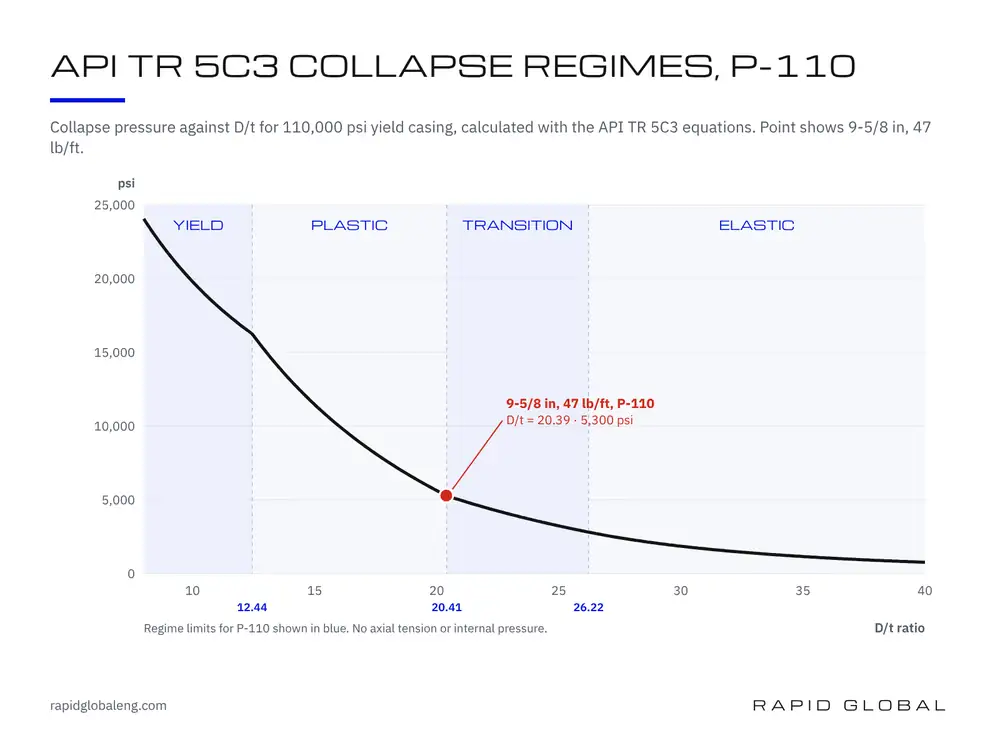
API TR 5C3 (now ISO/TR 10400) gives the equations used to publish collapse ratings for API casing. The method splits pipe into four regimes based on the ratio of outside diameter to wall thickness, D/t, and the yield strength. Our collapse pressure calculator uses the same method.
Why D/t matters
Thick-walled pipe (low D/t) fails by yielding: the wall is crushed. Thin-walled pipe (high D/t) fails by elastic buckling, like a can, at a pressure that has nothing to do with yield strength. Most real casing sits between the two, where failure is a mix of both and is described by empirical equations fitted to test data.
The four regimes
1. Yield strength collapse
For the thickest pipe. The pressure is the one that makes the inside wall yield:
Py = 2 Yp [ (D/t − 1) / (D/t)² ]
2. Plastic collapse
An empirical equation from test data, with coefficients A, B and C that depend on the yield strength:
Pp = Yp [ A / (D/t) − B ] − C
3. Transition collapse
Bridges plastic and elastic behaviour, with coefficients F and G:
Pt = Yp [ F / (D/t) − G ]
4. Elastic collapse
For thin-walled pipe. Independent of yield strength:
Pe = 46.95 × 10⁶ / [ (D/t) ( D/t − 1 )² ]
The D/t limits between regimes depend on grade. For P-110 (Yp = 110,000 psi) they are:
| Regime | D/t range, P-110 |
|---|---|
| Yield | up to 12.44 |
| Plastic | 12.44 to 20.41 |
| Transition | 20.41 to 26.22 |
| Elastic | above 26.22 |
Worked example: 9-5/8 in, 47 lb/ft, P-110
- D = 9.625 in, t = 0.472 in, so D/t = 20.39: plastic regime, just below the transition limit.
- For P-110: A = 3.181, B = 0.0819, C = 2,852.
- Pp = 110,000 × (3.181 / 20.39 − 0.0819) − 2,852 = 5,300 psi.
That matches the published API collapse rating for this pipe.
What the rating does not include
- Axial tension lowers collapse resistance. API TR 5C3 handles this by using a reduced effective yield strength. A string in heavy tension near the top can have a collapse rating well below the catalogue value.
- Internal pressure raises the effective collapse resistance.
- Wear, corrosion and ovality all reduce it. The ratings assume new pipe at minimum wall.
- Combined loading needs a triaxial check; see why burst and collapse checks alone are not enough.
Frequently asked questions
Why is collapse rating not proportional to grade?
In the elastic regime it does not depend on grade at all, and in the transition regime only partly. Upgrading the grade of thin-walled pipe gains little collapse resistance; adding wall thickness does.
What is the difference between API TR 5C3 and ISO/TR 10400?
See API TR 5C3 vs ISO/TR 10400.
Work with RAPID GLOBAL
RAPID GLOBAL designs, analyses and requalifies wellhead, subsea and valve equipment to API standards. If you need help with casing design or tubular analysis, talk to an engineer.