A casing or tubing string is only as good as its connections. Pipe bodies are made to tight standards, but most leaks and many failures happen at the threads. The choice between API connections and premium connections is one of the main cost and risk decisions in tubular design.
API connections
API 5B defines thread forms that any licensed mill can cut, so API connections are widely available and inexpensive.
8-round: STC and LTC
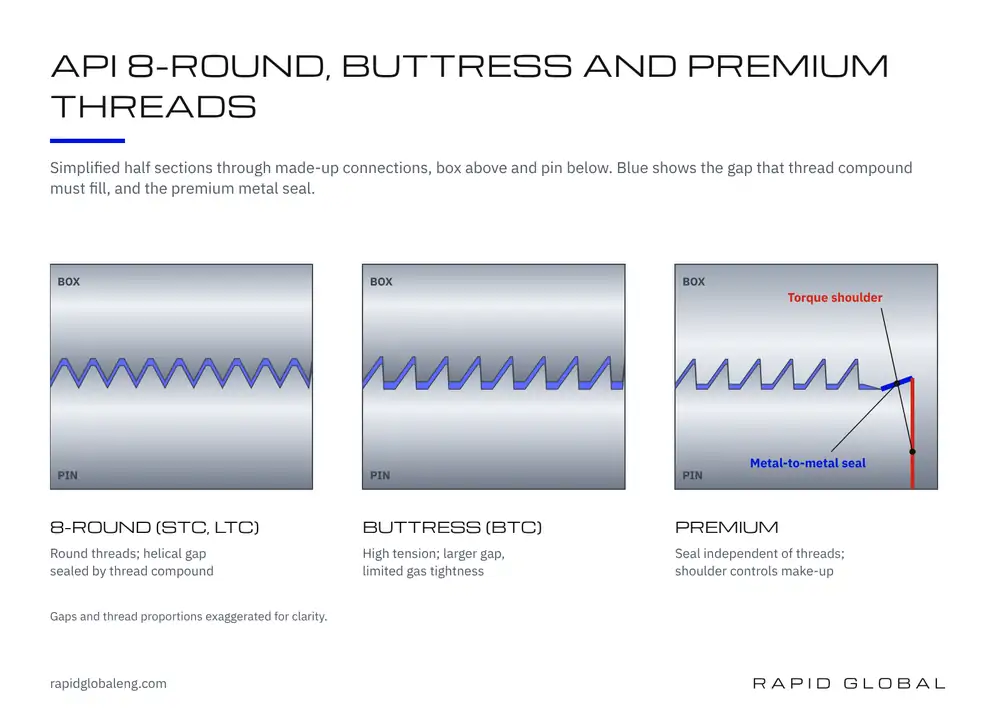
Round threads with eight threads per inch, in short (STC) and long (LTC) coupling versions. The threads seal by interference, but there is always a small helical gap between the crests and roots. Thread compound fills that gap. Long-term, at high pressure or with gas, the compound can be extruded or degrade, giving a leak path.
Buttress: BTC
An asymmetric thread with a near-flat load flank. It carries much higher tension than 8-round, often close to the pipe body strength, which suits long, heavy strings. Like 8-round, it relies on thread compound to seal, and the gap is larger, so gas tightness is limited.
Premium connections
Premium connections are proprietary designs from connection manufacturers. Most share three features:
- Metal-to-metal seal: a machined seal surface on pin and box that makes a radial interference seal, independent of the threads and thread compound.
- Torque shoulder: a positive stop that controls make-up position and protects the seal from over-torque. It also improves resistance to compression and bending.
- Optimised thread form: often a modified buttress or hooked thread for high tension and resistance to jump-out.
They come as coupled connections or as integral connections, including flush and semi-flush versions for tight clearances.
Comparison
| 8-round (STC/LTC) | Buttress (BTC) | Premium | |
|---|---|---|---|
| Seal | Thread compound | Thread compound | Metal-to-metal |
| Gas tight | No, in general | No | Yes, when qualified |
| Tension efficiency | Moderate | High | High |
| Compression and bending | Limited | Limited | Better |
| Cost | Lowest | Low | Higher |
When to specify a premium connection
- Gas wells and gas lift, where a small leak is unacceptable.
- High pressure or HPHT wells.
- Production casing and tubing that will see pressure cycles over the life of the well.
- Thermal wells, horizontal wells and wells with high bending or compression.
- Tight clearances needing flush or semi-flush connections.
For surface and many intermediate strings in oil wells, API connections remain the economical choice.
How premium connections are qualified
Premium connections are tested to API RP 5C5 / ISO 13679, which defines Connection Application Levels (CAL I to CAL IV). The higher levels include gas sealing under combined loads and thermal cycles. Ask for the test report and check that the tested envelope covers your load cases.
Frequently asked questions
Can I mix API and premium connections in one string?
Yes, with crossovers, and it is common: premium connections where they are needed, API connections elsewhere.
Do premium connections need special make-up?
Yes. Most require torque-turn monitoring and specific dope and running procedures from the manufacturer.
For grades, see API 5CT casing and tubing grades explained.
Work with RAPID GLOBAL
RAPID GLOBAL designs, analyses and requalifies wellhead, subsea and valve equipment to API standards. If you need help with connection selection or tubular analysis, talk to an engineer.