
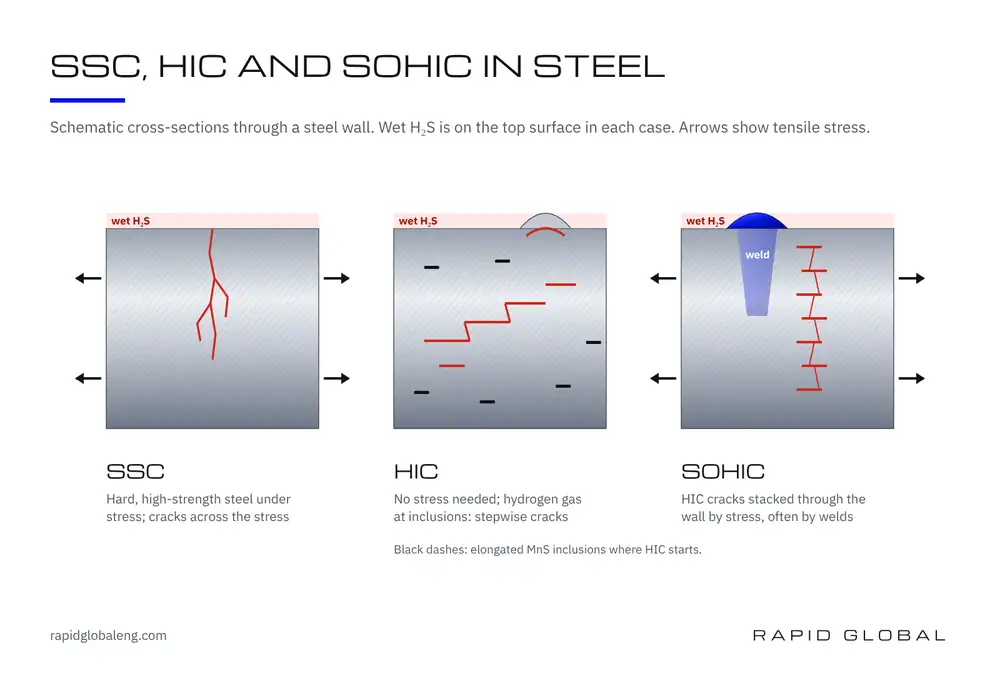
Hydrogen sulphide (H2S) in produced fluids lets atomic hydrogen enter steel. Once inside, that hydrogen can crack the steel in several distinct ways. The three most important for oil and gas equipment are sulphide stress cracking (SSC), hydrogen-induced cracking (HIC) and stress-oriented hydrogen-induced cracking (SOHIC). They have the same root cause but different triggers, so the controls are different too.
Where the hydrogen comes from
When steel corrodes in wet H2S, the corrosion reaction produces atomic hydrogen on the surface. Normally that hydrogen would combine into gas and bubble away, but H2S slows this step, so more atomic hydrogen diffuses into the metal. What happens next depends on the steel’s strength, its cleanliness and the stresses in it.
Sulphide stress cracking (SSC)
SSC is hydrogen embrittlement under tensile stress. Hydrogen collects in highly stressed regions and makes the steel brittle, so it cracks at stresses far below its normal strength. Cracks run roughly perpendicular to the stress and can be sudden.
- Most at risk: high-strength, high-hardness steels, hard weld zones and cold-worked areas.
- Main control: hardness limits. For carbon and low-alloy steels, NACE MR0175 / ISO 15156 generally limits hardness to 22 HRC, with heat treatment requirements.
- Test: NACE TM0177.
Hydrogen-induced cracking (HIC)
HIC happens without any applied stress. Hydrogen atoms collect at internal defects, mainly elongated manganese sulphide inclusions, and combine into hydrogen gas. The pressure builds until the steel cracks. Cracks run parallel to the surface and link up in a stepwise pattern. Near the surface, they can lift the steel into blisters.
- Most at risk: lower-strength rolled plate and pipe steels with high sulphur and poor cleanliness, such as line pipe and pressure vessel plate.
- Main control: clean, low-sulphur steel with inclusion shape control. Hardness limits do not prevent HIC.
- Test: NACE TM0284.
Stress-oriented HIC (SOHIC)
SOHIC is a hybrid. Small HIC cracks form, but tensile stress, often residual stress next to a weld, aligns them into stacks that link through the thickness. The result is a through-wall crack made of many small hydrogen cracks.
- Most at risk: welded plate and pipe in the heat-affected zone, especially without post-weld heat treatment.
- Main control: HIC-resistant steel plus stress reduction, mainly post-weld heat treatment.
Side by side
| SSC | HIC | SOHIC | |
|---|---|---|---|
| Needs tensile stress? | Yes | No | Yes |
| Crack direction | Perpendicular to stress | Parallel to surface, stepwise | Stacked through the thickness |
| Typical steels | High-strength, hard | Low-strength plate and pipe | Welded plate and pipe |
| Main control | Hardness limits, heat treatment | Clean steel, low sulphur | Clean steel, PWHT |
What this means for wellhead equipment
Wellhead and valve parts are mostly forged low-alloy steel, so SSC is the main concern, which is why API 6A sour material classes DD to HH follow NACE MR0175 hardness limits. HIC matters more for line pipe and vessels. Corrosion-resistant alloys used in class HH have their own cracking limits, including chloride stress corrosion cracking. See API 6A material classes.
Frequently asked questions
Does NACE MR0175 cover HIC?
Yes. ISO 15156-2 covers HIC and SOHIC for carbon steel plate and pipe, along with SSC.
When does a well count as sour?
See What is NACE MR0175? for the H2S partial pressure threshold.
Work with RAPID GLOBAL
RAPID GLOBAL designs, analyses and requalifies wellhead, subsea and valve equipment to API standards. If you need help with sour service material selection or failure analysis, talk to an engineer.

