
An API 6A material class tells you what the body and the trim of a piece of equipment are made of, and whether it is suitable for sour service. It is one letter pair on the nameplate, and it decides how well the equipment will survive the fluid it carries.
Body and trim
API 6A splits a part into two groups:
- Body: bodies, bonnets and end and outlet connections. These hold pressure.
- Trim: pressure-controlling parts such as gates, seats and stems, plus mandrel hangers. These control flow and see the fastest-moving fluid.
The classes
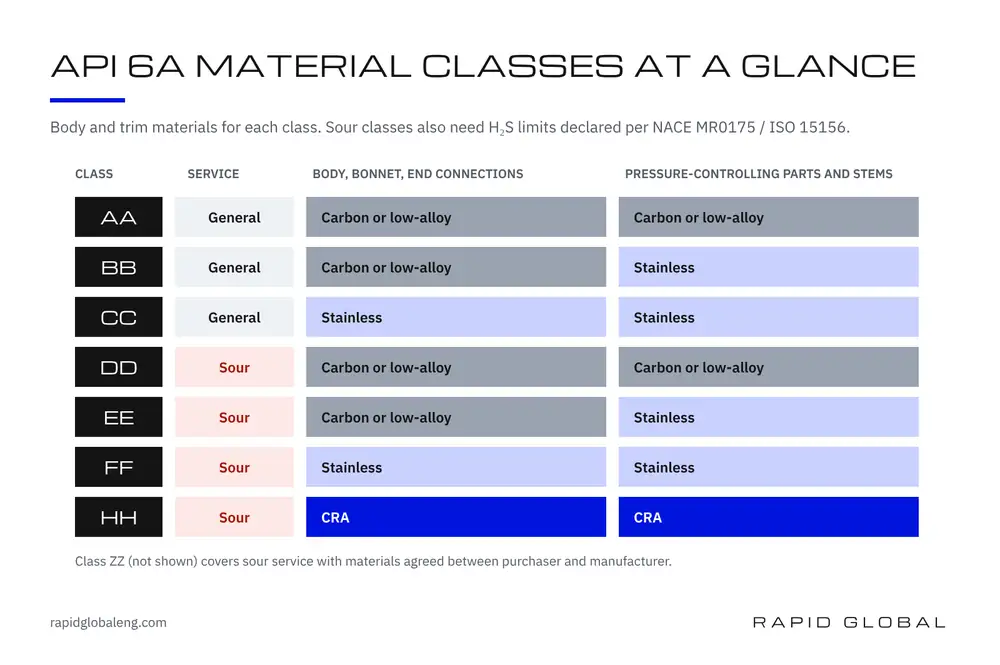
| Class | Service | Body | Trim |
|---|---|---|---|
| AA | General | Carbon or low-alloy steel | Carbon or low-alloy steel |
| BB | General | Carbon or low-alloy steel | Stainless steel |
| CC | General | Stainless steel | Stainless steel |
| DD | Sour | Carbon or low-alloy steel | Carbon or low-alloy steel |
| EE | Sour | Carbon or low-alloy steel | Stainless steel |
| FF | Sour | Stainless steel | Stainless steel |
| HH | Sour | Corrosion-resistant alloy (CRA) | CRA |
Class ZZ covers sour service with materials agreed between purchaser and manufacturer.
General vs sour service
Classes DD to HH must meet NACE MR0175 / ISO 15156, which limits hardness and controls heat treatment so the steel resists sulphide stress cracking. When you order sour-service equipment you also state the maximum H2S partial pressure, for example “DD-1.5” for 1.5 psia. Our NACE MR0175 post explains when a well counts as sour.
How to choose
- Dry, sweet oil or gas, low CO2: AA is usually enough.
- Sweet, but with erosion or mild corrosion at the trim: BB puts stainless where the flow is fastest.
- CO2 corrosion: CC, or EE and FF if H2S is also present.
- Any measurable H2S above the NACE threshold: DD at minimum.
- High H2S with CO2, chlorides or high temperature: HH, or carbon steel bodies with CRA-inlaid sealing surfaces.
The choice should come from a corrosion assessment of the produced fluid over the life of the well, not just today’s sample. Wells often sour as they age, particularly under water injection.
Frequently asked questions
Is HH always the safest choice?
It is the most corrosion-resistant, but it is also the most expensive and has the longest lead time. Many operators use DD or EE bodies with CRA inlays on ring grooves and seal areas instead.
Does the material class affect the pressure rating?
No. Pressure rating, temperature class, material class and PSL are separate parts of the specification.
See how material class fits with PSL in API 6A PSL levels explained.
Work with RAPID GLOBAL
RAPID GLOBAL designs, analyses and requalifies wellhead, subsea and valve equipment to API standards. If you need help with material selection for wellhead equipment, talk to an engineer.

