
Every piece of API 6A equipment carries a temperature class: a letter that sets the lowest and highest temperature the equipment is rated for. Get it wrong and elastomer seals harden in the cold or extrude in the heat, and steel can lose toughness.
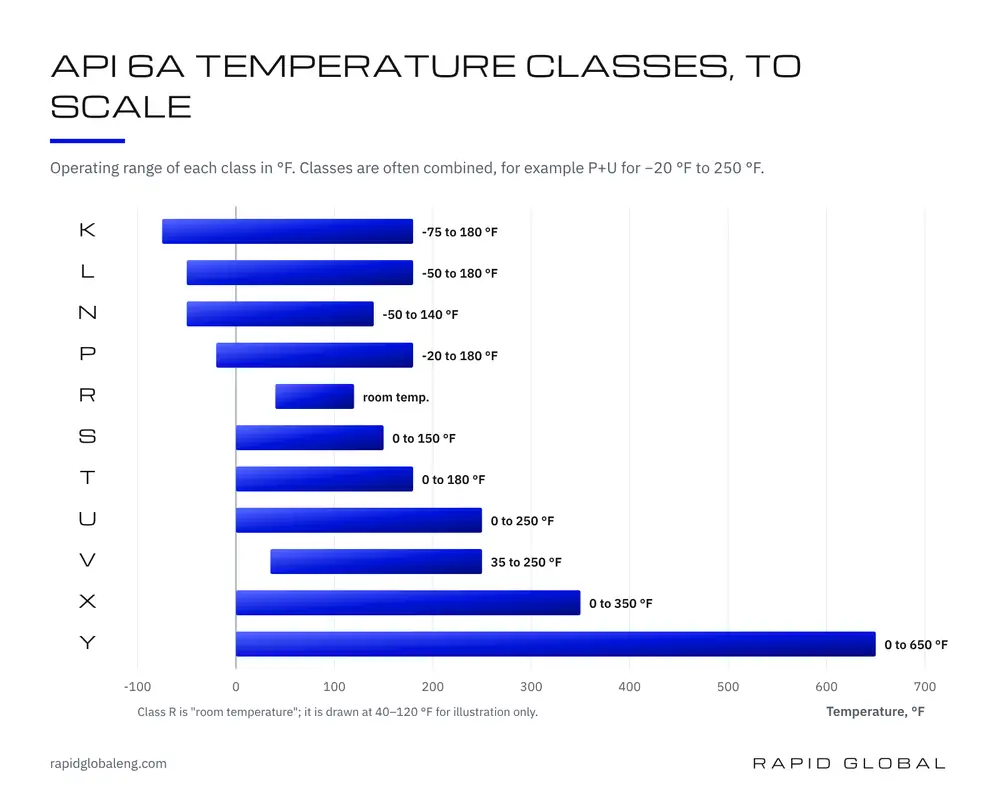
The classes
| Class | Minimum °F | Maximum °F |
|---|---|---|
| K | −75 | 180 |
| L | −50 | 180 |
| N | −50 | 140 |
| P | −20 | 180 |
| R | Room temperature | |
| S | 0 | 150 |
| T | 0 | 180 |
| U | 0 | 250 |
| V | 35 | 250 |
| X | 0 | 350 |
| Y | 0 | 650 |
Which temperature counts?
The minimum is usually set by the lowest ambient temperature the equipment will see, including during transport, storage and a cold start. The maximum is set by the hottest flowing fluid temperature at the wellhead. Both matter: a desert well can see sub-zero nights and hot production in the same week.
Combined classes
Many specifications combine two letters to cover a wider range, for example P+U for −20 °F to 250 °F. The equipment then has to be qualified at both ends of the combined range. Combined ratings are common for trees on hot wells in cold climates.
High-temperature classes
Classes X and Y take equipment well above normal production temperatures, for example on steam injection or HPHT wells. At these temperatures steel loses strength, so API 6A requires the working pressure to be derated. Soft seals are rarely suitable, so metal-to-metal sealing becomes the norm.
Why the class matters for seals
Most of the temperature limit comes from the non-metallic parts: stem packing, bonnet seals and hanger seals. An elastomer qualified to 180 °F may extrude at 250 °F, and one that is fine at 0 °F may leak at −20 °F. That is why temperature class goes hand in hand with PR2 validation testing, which cycles the equipment between its class limits. See PR1 vs PR2.
Frequently asked questions
What does class R mean?
Room temperature. It applies to equipment tested and used only at ambient conditions, and is rarely specified for field equipment.
Can a P-class valve be used at 200 °F?
No. Class P tops out at 180 °F. You would need class U, or a combined class such as P+U.
Temperature class sits alongside pressure rating; see API 6A pressure classes explained.
Work with RAPID GLOBAL
RAPID GLOBAL designs, analyses and requalifies wellhead, subsea and valve equipment to API standards. If you need help with HPHT or temperature-rated equipment, talk to an engineer.

