Rapid Global

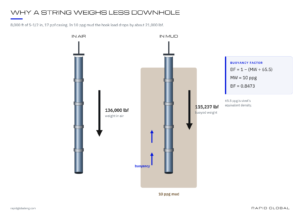
Buoyancy factor BF = 1 - MW/65.5: a 136,000 lbf string in 10 ppg mud weighs 115,237 lbf

Why Your String Weighs Less Downhole: The Buoyancy Factor Shortcut

Every string looks lighter once it’s in the hole. That’s not the rig lying to you — it’s buoyancy, and it’s why a driller’s hook-load reading never matches the pipe tally’s air weight once the string is wet. This post covers the shortcut oilfield engineers actually use to get from air weight to buoyed weight,

Why Your String Weighs Less Downhole: The Buoyancy Factor Shortcut Read More »
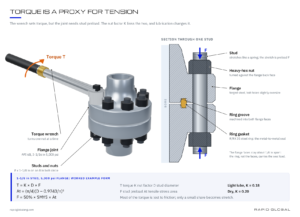
Flange joint torque and stud tension with ring gasket seal

Torque Is a Proxy for Tension: The Logic Behind Our Flange Bolt Torque Calculator

Torque specs on a bolted flange look precise — “450 ft·lbf, three passes, star pattern” — but the number behind that spec is built from a chain of assumptions, and the weakest link in that chain is almost always friction, not the bolt itself. Our Flange Bolt Torque calculator walks through that chain explicitly so

Torque Is a Proxy for Tension: The Logic Behind Our Flange Bolt Torque Calculator Read More »

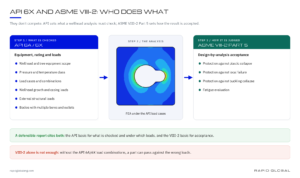
API 6A/6X sets what a wellhead analysis checks and under which loads; ASME VIII-2 Part 5 sets how the FEA result is accepted

API 6X vs. ASME BPVC Section VIII Division 2: Which Code Governs Your Pressure Equipment Analysis?

Two codes get named on almost every pressure-equipment analysis scope in this industry — API 6X and ASME BPVC Section VIII Division 2 — and it’s a fair question why you’d need both, or which one actually governs a given job. The short answer: they’re not competitors. One is a general pressure-vessel design code; the

API 6X vs. ASME BPVC Section VIII Division 2: Which Code Governs Your Pressure Equipment Analysis? Read More »

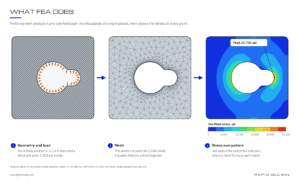
Finite element analysis of a valve body section: geometry and pressure load, mesh, and von Mises stress result

What Is FEA (Finite Element Analysis) and Why Does It Matter for Pressure Equipment?

No one builds a physical wellhead, bolts it up, and pressure-tests it to destruction just to find out where it would fail — and even if you did, that single test wouldn’t tell you what happens at a different temperature, a different load combination, or a slightly different wall thickness. That’s the gap Finite Element

What Is FEA (Finite Element Analysis) and Why Does It Matter for Pressure Equipment? Read More »

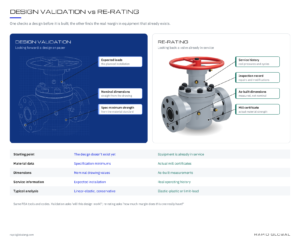
Design validation compared with re-rating by analysis

Design Validation vs. Re-Rating by Analysis: What’s the Difference (and When Do You Need Each)?

“Can you analyze this for us” means two different jobs depending on whether the part exists yet. Design validation checks a new design before it’s built. Re-rating (or re-qualification) checks an existing, already-proven design against a duty it wasn’t originally analyzed for. They use the same FEA tools and the same codes, but the question

Design Validation vs. Re-Rating by Analysis: What’s the Difference (and When Do You Need Each)? Read More »

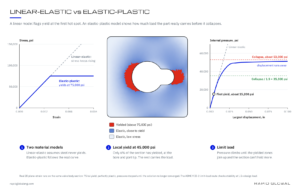
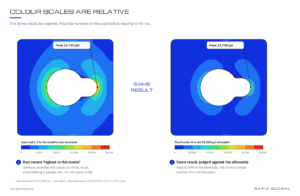
Stress-strain models, local yield zone and pressure-displacement curve to collapse for a valve body section

Elastic-Plastic vs. Linear-Elastic FEA: When Do You Actually Need Limit-Load Analysis?

Run a linear-elastic FEA on a pressure-containing component and it’s common to get a result that says the design fails — calculated stress above yield at a local hot spot — on a part that, in reality, has years of safe service behind it or would clearly survive a hydrotest. That’s not a wrong answer;

Elastic-Plastic vs. Linear-Elastic FEA: When Do You Actually Need Limit-Load Analysis? Read More »

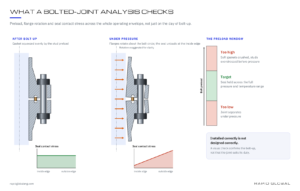
Flange joint after bolt-up and under pressure, showing flange rotation, seal contact stress and the preload window

Flange Bolted-Joint Analysis: Why “It Passed Visual Inspection” Isn’t a Compliance Check

A flanged connection that looks fine — bolts torqued to spec, gasket seated, no visible gap — can still be one thermal cycle or one pressure surge away from a leak path. Visual inspection and correct installation torque confirm the joint was built right; they don’t confirm it was designed right for the loads it

Flange Bolted-Joint Analysis: Why “It Passed Visual Inspection” Isn’t a Compliance Check Read More »

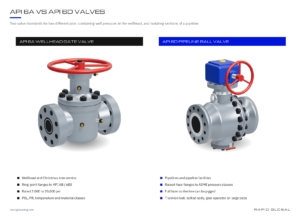
API 6A wellhead gate valve compared with API 6D trunnion ball valve

API 6A vs. API 6D: What’s the Difference Between Wellhead and Pipeline Valve Standards?

API 6A and API 6D both cover valves used in oil and gas service, and it’s a common point of confusion which one applies to a given piece of equipment. The short version: it comes down to where the valve sits. API 6A governs wellhead and tree equipment; API 6D governs pipeline valves. Same broad

API 6A vs. API 6D: What’s the Difference Between Wellhead and Pipeline Valve Standards? Read More »