Calculators & Tools

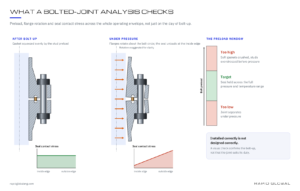
Flange joint after bolt-up and under pressure, showing flange rotation, seal contact stress and the preload window

Flange Bolted-Joint Analysis: Why “It Passed Visual Inspection” Isn’t a Compliance Check

A flanged connection that looks fine — bolts torqued to spec, gasket seated, no visible gap — can still be one thermal cycle or one pressure surge away from a leak path. Visual inspection and correct installation torque confirm the joint was built right; they don’t confirm it was designed right for the loads it

Flange Bolted-Joint Analysis: Why “It Passed Visual Inspection” Isn’t a Compliance Check Read More »

Choke manifold used to circulate out a kick

Choke and Kill Manifold Design: What Actually Goes Into Sizing One

A choke and kill manifold looks like a dense cluster of valves, chokes, and pipe spools, and sizing one properly means working through several interlocking decisions at once — pressure rating, choke sizing, redundancy, and line routing — each of which constrains the others. Here’s what actually goes into that. Start with the pressure rating

Choke and Kill Manifold Design: What Actually Goes Into Sizing One Read More »

Burst, collapse and axial load cases on casing and tubing

API TR 5C3 vs. ISO/TR 10400: Are They Really the Same Standard?

API TR 5C3 and ISO/TR 10400 both show up as the cited basis for casing and tubing burst, collapse, and tension calculations, and it’s a fair question whether picking one over the other actually changes anything. The short answer: for the core equations, no — ISO/TR 10400 was developed specifically to be the internationally-recognized equivalent

API TR 5C3 vs. ISO/TR 10400: Are They Really the Same Standard? Read More »