
API 6A equipment is ordered at a Product Specification Level, or PSL. The PSL sets how much testing, inspection and record-keeping goes into a part. It does not change the pressure rating. A 5,000 psi gate valve is a 5,000 psi valve at PSL 1 or PSL 4; what changes is how much evidence you get that it was built correctly.
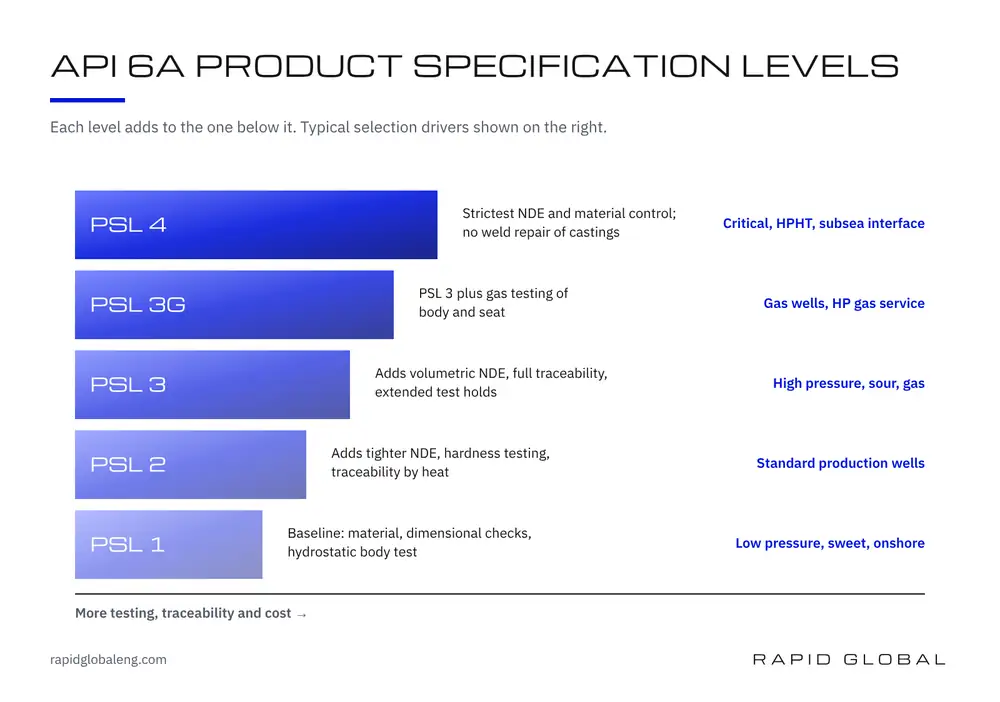
The five levels
- PSL 1: the baseline. Material requirements, dimensional checks and a hydrostatic body test.
- PSL 2: adds more inspection, hardness testing and traceability to the material heat.
- PSL 3: adds volumetric examination such as radiography or ultrasonics, full traceability of each part, and longer test holds.
- PSL 3G: PSL 3 plus a gas test of the body and seats, for equipment in gas service.
- PSL 4: the strictest level, with the tightest examination and material controls. Some repairs allowed at lower levels are not permitted.
Each level includes everything in the levels below it.
How operators choose a PSL
API 6A gives guidance on selecting a PSL based on the risk of the application. The main drivers are:
- Pressure: higher working pressure pushes towards PSL 3 and above.
- Sour service: H2S raises the consequence of a failure.
- Gas well: gas is harder to contain than liquid, which is why PSL 3G exists.
- Location: proximity to people, water or sensitive environments, and whether the well is offshore.
In practice, many operators write their own minimum PSL into company specifications, often PSL 3 or 3G for high-pressure or sour wells.
Cost and lead time
Higher PSLs cost more and can add weeks to lead time because of the extra inspection, documentation and witnessed testing. Over-specifying PSL on a low-risk land well adds cost without reducing risk much. Under-specifying it on a sour gas well removes the evidence you rely on when something goes wrong.
PSL is not PR or material class
Three separate choices are often confused:
- PSL covers manufacturing quality and testing.
- PR1 or PR2 covers design validation; see our PR1 vs PR2 post.
- Material class, AA to HH, covers materials for the fluid; see API 6A material classes.
A complete specification names all three, plus the pressure and temperature rating. For example: 3-1/16 in 5,000 psi, temperature class P+U, material class DD, PSL 3, PR2.
Frequently asked questions
Can I upgrade a PSL 2 valve to PSL 3?
Not after the fact. PSL 3 depends on records and examinations made during manufacture, which cannot be recreated later.
Does PSL apply to every part of a valve?
PSL applies to the pressure-containing and pressure-controlling parts named in API 6A, such as bodies, bonnets, end connections, gates and seats.
New to the standard? Start with our introduction to API 6A.
Work with RAPID GLOBAL
RAPID GLOBAL designs, analyses and requalifies wellhead, subsea and valve equipment to API standards. If you need help with specifying API 6A equipment, talk to an engineer.

