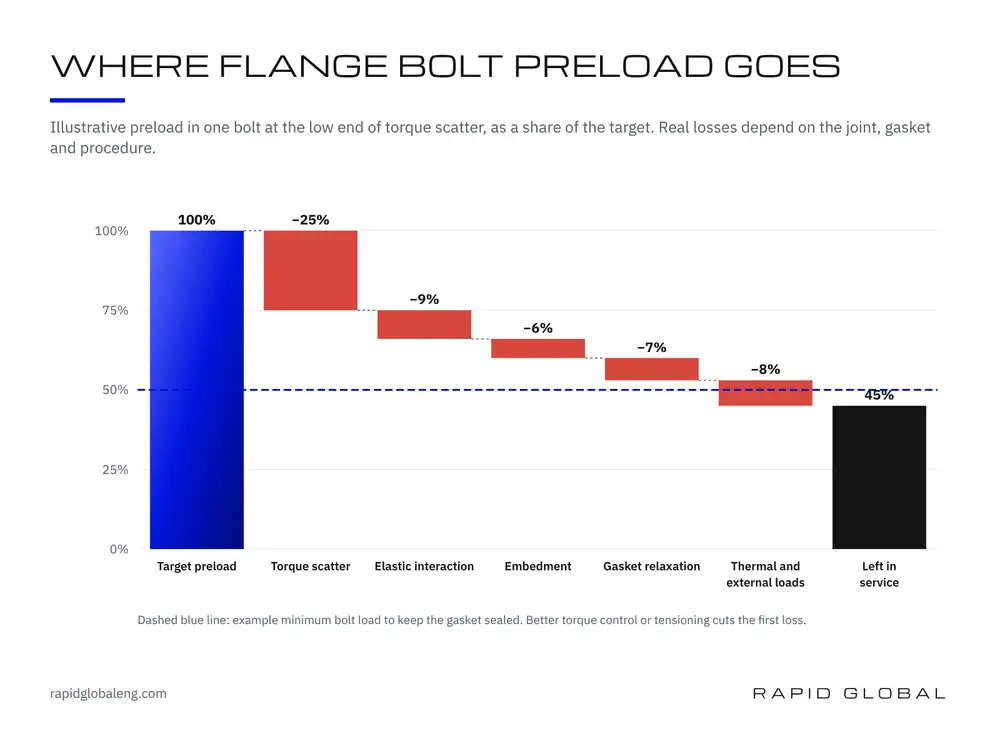
A flanged joint seals only while the bolts hold enough load on the gasket. Most flange leaks are not caused by a bad gasket or a damaged face. They happen because the bolt load was lower than intended from the start, or dropped after assembly. Understanding where the load goes is the key to stopping leaks.
1. Not enough load to begin with
Torque is only a proxy for bolt tension. Most of the applied torque goes into friction under the nut and in the threads, and that friction varies with lubricant, surface finish and thread condition. With a torque wrench, the actual preload can scatter by around ±25% or more from the target. Some bolts in a joint end up well below the load the design assumed.
Our flange bolt torque method explains the nut factor and why lubricant choice matters so much, and the flange bolt torque calculator turns a target preload into a wrench setting.
2. Elastic interaction during tightening
When one bolt is tightened, it compresses the gasket a little more, which relaxes the bolts already tightened. This is called elastic interaction or cross-talk. Tightening in a single pass round the flange can leave the first bolts far below target. The fix is a cross pattern and several passes at increasing torque, as described in ASME PCC-1.
3. Embedment
Surface roughness under the nut, on the flange face and in the threads flattens under load in the first hours. The bolt shortens slightly and loses tension. Short bolts lose a larger share of their stretch, so they are more affected.
4. Gasket creep and relaxation
Soft and semi-metallic gaskets continue to compress over time, especially when hot. As the gasket thins, bolt load drops. Metal ring joints relax far less, which is one reason they are used for high pressure; see R vs RX vs BX ring gaskets.
5. Thermal transients
During start-up or a temperature change, the flange, bolts and gasket heat at different rates. If the bolts get hotter than the flange, they grow more and lose load. Different materials, such as stainless bolts in carbon steel flanges, make this worse.
6. External loads
Pipe bending and axial loads unload the bolts on one side of the flange. A joint that holds pressure on the test bench can leak in service once piping loads are applied. Flange design should include external loads, not just pressure.
How to prevent leaks
- Set the target preload from the gasket’s needs and the bolt’s strength, not just a standard torque table.
- Use a known lubricant and the matching nut factor.
- Tighten in a cross pattern in several passes, then do a final check pass round the flange.
- Consider hydraulic tensioning for large or critical joints; it controls preload far better than torque.
- Use longer bolts or spacers where possible: more stretch means less loss from embedment.
- Check flange faces, ring grooves and ring condition before assembly. Never reuse ring gaskets.
- On RTJ joints, check standoff all round for even make-up.
- Include thermal and external loads in the design check. Our bolted joint analysis post shows what an FEA check covers.
Frequently asked questions
Should flanges be retorqued after start-up?
Hot retorquing is sometimes used to recover relaxation, but it carries risk on a live system and must follow a written procedure. Getting the initial preload right is better.
Is a higher bolt load always better?
No. Too much load can crush a gasket, overstress the bolts or yield the flange. The target is a range, not a maximum.
Work with RAPID GLOBAL
RAPID GLOBAL designs, analyses and requalifies wellhead, subsea and valve equipment to API standards. If you need help with flange or bolted joint analysis, talk to an engineer.